by John Ellis
(As a head’s up: The footnotes in this article are important. You don’t want to skip them.)
When 17 Kids and Counting – eventually 18 Kids and then 19 Kids and Counting – first began airing on TLC in 2008, it quickly became a hit in white evangelical circles. It was embraced as a wholesome show that was not only family friendly but one that actively promoted Christian family values. Many people believed that Hollywood was finally showing Christianity – specifically the Christian lifestyle – without caricaturizing or mocking it. Hindsight reveals how horribly wrong the fans of the show were to venerate it. 19 Kids and Counting was a deceitful picture of Christianity and a dangerous propaganda tool for Bill Gothard’s IBLP’s oppressive, theologically aberrant, and abusive teachings.
When the show first began airing, my wife watched it some. At the time, TLC had a plethora of reality shows centered on “interesting” family dynamics like Jon & Kate Plus 8 and Little People, Big World. With a toddler in our apartment, it wasn’t unusual for our TV to be employed in the service of white noise. During that time period, TLC rose to the top of the list of “channels with program interesting enough to catch my wife’s eye but not to interesting as to distract her from the job(s) at hand.” The reality show about a large Christian fundamentalist family merged nicely into that lane.
Having married in 2005, we were still basically newlyweds when the show began. We were both raised within the weird world of Christian fundamentalism, and both of us had a dad who was an independent fundamental Baptist pastor. For my part, I had left fundamentalism years earlier, having never really been a part of it to begin with. My wife, on the other hand, was still working through what it meant to be a Christian (and a wife and a mother) removed from fundamentalism. I didn’t ask her why the show resonated with her, however much it did, but I imagine that it felt familiar for her during a time of transition in her life.[1]
Over the years, the show has come up in conversations from time to time. The most notable being a conversation I had with a man who was a member of our church in Arlington, VA. This man knew Josh from the eldest Duggar kid’s work with the Family Research Council’s lobbing PAC FRC Action. I had made some disparaging comments about the Duggars on social media, and my fellow church member felt compelled to defend his friend and friend’s family. My response was that any parents who would sign their kids up to be on a reality TV show are not safe parents for their kids and that the kids should probably be removed from the home.[2]
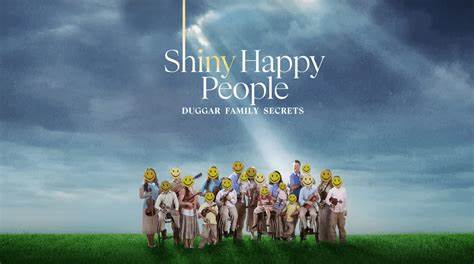
While not as harsh as my assessment, Amy Duggar King, the Duggar’s cousin, confessed during the first episode of Amazon Prime’s new documentary Shiny Happy People: Duggar Family Secrets that, “It’s a constructed reality. … It’s reality, but it’s not.”
Amy Duggar King’s comment speaks to my point: reality TV is scripted.[3] When children whose brains are still developing live within that “constructed reality,” it has a negative impact. Clearly, 19 Kids and Counting has had an unsettling negative impact on the Duggar children. The well-produced documentary lays that tragic fact bare.
Earlier this week, a friend who grew up smothered and buried in Bill Gothard’s abusive world of IBLP and is currently doing the hard work of deconstruction texted me and asked if I was going to watch the documentary. Up to that point, I wasn’t aware of the project’s existence. After frantically googling, I told him I would probably watch it, and I did.
It’s only 4 short episodes, but those 4 episodes pack an emotional punch that’s equal parts infuriating and heartbreaking, even if you are already aware of much of the documentary’s content. I’m pretty well versed in Bill Gothard and his teachings. While my parents weren’t Gothardites, I knew many kids whose parents were. However, my understanding of Gothard and his teachings have expanded as an adult. Much of what I learned about it as a kid was foggy and hard to disconnect from what I was being taught at home, school, and church because it was very similar.[4] A very vocal Gothardite (are there any other kind?) began attending our church in Arlington a few years ago. I dug into the teachings of Bill Gothard in order to better prepare myself and my fellow elders to deal with any coming storms. While not an expert in Gothardism, and not having attended IBLP, I was taught much of it under different guises and names as a kid. My study of the movement as an adult has helped me see and articulate the parallels.
There were things in the documentary that I didn’t know about, though. Previously, I was unaware of Gothard’s creepy paramilitary militia made up of teenage boys, for example. And while watching the show, several approaches competed in my mind to be the thesis for this article.[5] What won out is this: The documentary Shiny Happy People: Duggar Family Secrets exposes more than just the disfunction and abuse in one family. It’s an expose about the rotten, not-so-secret oppressive world of Christian fundamentalism. It also serves as a warning to all conservative white evangelicals to be careful about judging Gothardites and other fundamentalists before taking the beam out of our own eye. Many of the same core problems found in fundamentalism plague the broader world of white evangelicalism, too. First, though, fundamentalism.
It’s tempting to view the Duggar Family and others entrenched in Bill Gothard’s IBLP as “not us.” Many in Christian fundamentalism cling tightly to that haughty perspective when discussing Gothard. Except, whether they attended Gothard’s core seminars or not, there is very little daylight between the awfulness of Gothard’s IBLP and the rest of Christian fundamentalism.
Four years ago this month, I was rewriting, with the purpose of turning it into a book, an autobiographical series I had posted on my previous blog. Working with an acquisitions editor from Crossway, I labored diligently to produce a memoir that was true and edifying.[6] My objective was to write something that could be an encouragement to parents with adult children who have rejected Christianity and to provide a compelling narrative about one such adult child (me) that might resonate with lost souls who are hurting and seeking. You can read that memoir, if you’d like. It’s posted under The Godless Fundamentalist tab of this blog. If you do so, here’s something I’d like you to understand (and something I’d like those who’ve already read it to understand): something can be factually true without being the whole truth.
To the best of my ability and memory, my memoir is factually true. I can point you to people who will testify to the truthfulness of some of the more dramatic moments in my life. However, because of the objectives I shared above, the memoir only tells part of my story. If I were to rewrite it, my memoir would take on a different tone and have different objectives than its current iteration. If you do read that current iteration, pay close attention to the “Introduction” (you can read it by clicking here). I believe the “Introduction” to A Godless Fundamentalist is not only the best written part of it but is also the most truthful.
I often tell people that A Godless Fundamentalist feels like two different books. And that’s because it largely is. What I wrote in the “Introduction” kept finding its way into the body of the book, and I found it a struggle to keep what I wrote in it from undermining my objectives. In my heart, I knew that I should rewrite the “Introduction” to better match those objectives, but I was (am) super proud of it and couldn’t bring myself to change it. If I were to rewrite my memoir, I’d keep the “Introduction” and rewrite the rest of it. Watching Shiny Happy People reminded me of that “Introduction.” What I want to say about the documentary is a little of that truthfulness lacking in the rest of A Godless Fundamentalist. While I didn’t grow up in Gothardism, in many ways I may as well have.
The refrain, “they wanted to protect us from the world” echoes throughout the four episodes. In my memoir, especially chapter 2, I did write about this aspect of my upbringing that intersects with the Duggars and the world of Gothardites. Christian fundamentalism, including my parents and other authority figures, took Proverbs 22:6 as a promise from God. You know, “Train up a child in the way he should go, and when he is old he will not depart from it.” Before she died, my mom confessed to me that she had believed that I was simply lukewarm to the things of God and that if she could just get me safely to Bob Jones University, God would fulfill the promise of Proverbs 22:6 by igniting my heart for God. Her job, as she saw it, was to protect me from the world until I left for BJU.
In doing so – protecting me from the world – my parents misinterpreted and misapplied Jesus’ parable of the soils. They believed their job was to prevent any weeds from choking out the gospel seed that had been planted in my heart. And by weeds they meant things like rock music, movies, physical contact with girls, and video arcades (the actual list is quite long). Not only were my parents not an anomaly in fundamentalism, but they were also on the more “moderate” side compared to many fundamentalists.
While I couldn’t play with Masters of the Universe toys (much less watch the cartoon), at least I could watch The Smurfs, something many of my friends were forbidden to do. My sisters had homemade Cabbage Patch Dolls only because my parents couldn’t afford the real thing. Many families in our communities were scandalized by those homemade dolls. I was allowed to wear shorts while playing outside, but I had friends who had to wear sweatpants even while playing organized basketball. The one thing my parents were as strict as possible about was rock music. Going to the movie theatre was also anathema in my house.
While using my life as an example, I also don’t want this to be about me. My point is that the world of fundamentalism, even apart from Bill Gothard, contains a maze of rules that are contradictory and legalistic.
The word legalism and its cognates are tricky and can be a moving target. Because of the easy believism that permeates fundamentalism (and much of white evangelicalism), my accusation of legalism resides less in the realm of soteriology and more in the realm of sanctification. The higher life of Keswickianism has a doctrine of sanctification that creates a hierarchy of Christians.[7] While you may be unfamiliar with the terms of the previous sentence, I’m guessing that most readers are familiar with the concepts. Think of the alter call to rededicate your life to God. You can be “saved by the skin of your teeth” and miss out on temporal and eschatological blessings because you haven’t surrendered your life to God. You’re also cutting yourself off from the full power of the Holy Spirit. In practice, this means that those farther down the ladder of Christian hierarchy (and this isn’t even really touching on Gothard’s umbrella metaphor yet) are to submit to those above them. This creates relational dynamics that are easily utilized in the service of abuse. I mean, if I am closer to God and am availing myself of the full power of the Holy Spirit and you’re not, what right do you have to question me? The answer, in the world of fundamentalism: you don’t.
Looking back to my personal anecdote, I also want to be clear that I’m not intending to write a “the rest of us in fundamentalism had it just as bad” type of comparison. By no means do I want this to turn into a “who had it worse” argument. Even during my childhood, I was fully aware of how much worse off many of my friends whose parents were Gothardites had it, even if I didn’t understand it all. My objective is to point out that broader fundamentalism is not only capable of the same abuses but has been frequently guilty of them because broader fundamentalism clings to the same idol of hierarchal authority taught by Bill Gothard. As does the world of “mainstream” white evangelicalism (see footnote #7).
Examples abound. My problem is where to begin and what to leave out. As the father of an almost four-month-old daughter, one thing in the documentary stood out to me, angering me, in fact. The belief that the parents’ job is to break the will of their children is not unique to IBLP. Growing up, and into my time as a student at Bob Jones University, I was frequently taught that babies are sinfully rebellious. I remember hearing how crying babies are often lying because they simply want attention. In those instances, the parents are to spank the infant.
I don’t know if I was spanked as an infant or not (some of my earliest memories do include spankings), but I do know that my parents believed that corporal punishment was the only biblically legitimate form of discipline. A little over a year ago, during a brief stop at my dad’s house, he called me into his bedroom. Later in the car, as we continued our drive to New Orleans, I told my wife that when he did so my heart jumped into my throat and when I walked into the room and saw the belts hanging on his closet door, fear briefly washed over me. My dad merely wanted to show me the bathroom renovations, but my response speaks to the conditioning of my mind and body to being called by my dad into his bedroom. For a little context, my last spanking was when I was a junior in high school.[8] My experience is far from unique in fundamentalism.
Delving deeper into the problems of authoritarian structures, Gothard’s umbrella of hierarchy was/is widespread in fundamentalism. I can’t think of a fundamentalist organization that didn’t teach me the core belief of the umbrella, even if they didn’t use the metaphor. Obeying the authority over you is requisite for achieving God’s blessings. In Shiny Happy People historian Kristin Kobes Du Mez points out that, “They teach the prosperity gospel. Obey God, and God’s going to bless you. … If you’re under the umbrella of authority, nothing bad can happen to you.”
While she was speaking of Bill Gothard and IBLP, her words ring true across the board in fundamentalism. I was taught that one of the keys to a long, prosperous life was joyful obedience (the first time) to my parents and other authority figures. Obey right away and without question. That “without question” is as wide open a door to abuse as any within fundamentalism. Sheltered, naïve children who are socially conditioned to obey right away without question make for easy prey.[9]
One more personal anecdote to illustrate how this parent/child authority hierarchy doesn’t have an expiration date.
When I became a pastor several years ago, I called my dad. While the phone rang, I thought, “This is finally something that he will be proud of me about.”[10]
Nope.
After I told him, he was quiet for a few seconds and then quietly said, “Well, I’m happy that you’re happy.”
That was an odd way to word it, and so I pushed him on it. He sighed and told me that he believed I was disqualified from being a pastor. I assumed he meant my divorce and remarriage, but that’s not what he meant. He told me that I was in direct disobedience of Ephesians 6:1 that says, “Children, obey your parents in the Lord, because this is right.” Listing off a series of things of how I was disobeying him – being a Calvinist, having a beard, and my music standards – my dad concluded by telling me, “There are things I still don’t do to this day because Papa [his father] was against it.”
Don’t be fooled. Patriarchalism is at the very heart of fundamentalism. I know that claim is anecdotal and not research based, but sitting here, I tried to count the number of people I know or have met who’ve entered adulthood wrecked in various ways – physically, emotionally, psychologically, existentially, etc. – by fundamentalism’s patriarchy, but attempting to do so is overwhelming. The brokenness of those who were raised in fundamentalism is the evidence. If you want more evidence, and my fundy street cred is legit[11], there’s not a fundamentalist institution or leader in my life who didn’t teach, preach, or promote forms of patriarchalism. Dad is king of the castle, and his word is law. Any questioning of dad equals ungodly rebellion against God’s ordained authority figure.[12] And if dad is outside of God’s will/authority, as defined by the pastor, then the individual is to look to the pastor as his or her final authority.
The spotlight spills over into broader white evangelicalism here, too. The soft-patriarchalism of the complementarian movement, especially as articulated by organizations like CBMW, is a breeding ground for abuse. The #ChurchToo movement exists for a reason. The Houston Chronicle’s recent expose of the Southern Baptist Convention’s problems with abuse and sexual assault exists for a reason. The marginalization and demonization of critical female voices during the ongoing dustup over Beautiful Union by Josh Butler exists for a reason. This soft-patriarchalism is infected by Aristotle’s (and Augustine’s) belief that ontologically women are simply lesser men – not just lesser than men, although that’s part of it too, but lesser men (ironically, Darwin believed a similar thing). And the rise of the toxic theobro movement derives much of its theological underpinnings from the writings of John Piper and Wayne Grudem’s manifesto Recovering Biblical Manhood and Womanhood.
Early in the book, Piper glorifies his father because, “He drove the car. He guided the family to where we would sit. He made the decision to go to Howard Johnson’s for lunch. He was the one who guided us to the table.”[13] While a seemingly innocuous list of decisions, it betrays the aberrant belief that the husband/father is the umbrella taught by Bill Gothard. If you keep reading the book, you’ll find that Piper believes that “The God-given sense of responsibility for leadership in a mature man will not generally allow him to flourish long under personal, directive leadership of a female superior. … Some of the more obvious ones would be in military combat settings if women were positioned so as to deploy and command men; or in professional baseball if a woman is made to call balls and strikes and frequently to settle heated disputes among men. And I would stress that this is not necessarily owing to male egotism, but to a natural and good penchant given by God.”[14]
Did you hear that, females? If you’re a manager at work and your male subordinate rebels against your leadership, it’s not egotism. It’s “a natural and good penchant given by God.” To be fair, if fairness is possible here, Piper would undoubtedly encourage the male’s rebellion to be gracious and kind. And if you think this is all strawmanning abstracts on my part, my wife once offered a friend a job. This friend was in desperate need of a job, especially since his theology taught that his wife was designed by God to stay at home. The job my wife offered paid well and had excellent benefits. While our friend believed that he had a God-ordained duty to be the breadwinner for his family, that belief was put in subjection to his belief in God-ordained gender hierarchies. He turned the job down because he didn’t believe he should place himself under my wife’s authority.
I understand that this is hard to hear for some readers (some of my friends). I understand that for many people in my circles, John Piper exists in the realm of the sacrosanct and any criticism of him is met with resistance. But this is important, no matter how hard it is to hear. The power dynamics of complementarianism have very close parallels to Bill Gothard and IBLP, to the point of being indiscernible from each other at times. Happy Shiny People may be about a specific family and movement that you believe is far removed from you. But maybe, just maybe, it isn’t. Maybe the hurting voices pointing fingers at complementarianism have a message we need to hear and heed. For the record, I believe they do. I’m asking you to honestly take a hard look at these parallels and see if you can spot red flags. I’ve pointed readers to just a couple red flags, but there are many more. Listen to survivor movements. Listen to what women have to say about books like Beautiful Union and not to the male-centered power structures and platforms denouncing those criticisms as the spiteful voice of a mob. Authoritarian hierarchies work hard to squash any resistance to their self-created power. And please hear this: just because the condescending power hierarchies exist doesn’t mean you’re required to submit to them.
But I’m not finished.
Other close parallels between Gothardism and broader fundamentalism exist (and white evangelicalism as a whole). One of the more impactful parallels is the toxic teaching on modesty and purity.
While the articulations of it are a little more extreme in Gothardism – although the differences are probably indiscernible for outsiders – the unhealthy teachings on modesty for girls is not just rampant in fundamentalism, it’s a core tenet. The purity culture (and this one of the areas where obvious crossover can be found in broader white evangelicalism) demonizes females while reducing males to their worst instincts.
The shame over their bodies shoveled onto females, as well as being burdened by the teaching that it is their responsibility to not be “eye traps,” combined with the drumbeat to males that their natural relationship with females is one of lust undermines any chance at biblical community and unity. Females and males are pitted against each other, and females are saddled with the greater responsibility for the sin of men. I originally put this next part in a footnote, but concluded it was too important: Look, if this hasn’t been your experience within the purity culture, that doesn’t mean it’s not true. Your experience isn’t the arbiter of truth over the experience of others. Instead of defending the purity culture, maybe you should adopt a position of humility and listen to the experiences of those who have been hurt by it and learn from them. There’s also a chance that you were a kid and weren’t aware enough to recognize what I, and others, am talking about.
I’ve already written about the purity culture and I’m not going to rehash it here. I encourage you to click here to read about how the purity culture warps male’s perspective on females. For a female perspective on the purity culture’s harmfulness, I point you to Sheila Gregoire as a truthful voice and helpful resource (click here). The purity culture is toxic, whether it’s the purity culture of Bill Gothard and fundamentalism, or in the world of white evangelicalism as articulated by Emmerson Eggerichs, John Eldredge, Randy Alcorn, CBMW, etc., and it has and will continue to produce great harm if we don’t denounce, reject, and dissemble it.
After I became an adult, I learned that several of the females I knew growing up had suffered abuse and/or sexual assault. I talked about one case with an old friend of mine, and we talked about how at the time we had no idea. But how could we? For one thing, the power hierarchies were more concerned with protecting their power than with honesty. For another thing, we were taught to view females as objects of desire. Even if we had been given the tools to recognize abuse, I think we would’ve had a hard time recognizing the abuse of a female because we weren’t taught to view females as fully as human as males. I also have little doubt, sadly, that the abuse I’ve learned about is only the tip of the iceberg.
This article is also just the tip of the iceberg of the thoughts I had while watching Shiny Happy People. Even with that, I realize that the thoughts and beliefs I’ve expressed in this article are somewhat scattergun. Hopefully, the through-line-of-action is still apparent.
Scanning the landscape of fundamentalism and the broader world of white evangelicalism after watching Shiny Happy People: Duggar Family Secrets and the parallels stand out. To be sure, the toxicity and innate abusive nature of Bill Gothard and IBLP are more easily recognizable (“thanks” in large part to TLC’s platforming of the Duggars and Gothardism). But that same toxicity exists across the fundamentalism as a whole. Broader white evangelicalism isn’t off the hook, either. The attachment to man-made power hierarchies is centered across the board. And at its core, those man-made power hierarchies are what create and enable abuse. People in our pews are hurting. Those who used to sit in our pews but have left/have deconstructed are hurting. Helping them heal requires recognizing our complicity, our repentance, and a willingness to listen and learn from those deemed dangerous or bitter or part of a mob by those intent on protecting their own power. Remember, just because condescending power hierarchies exist doesn’t mean we have to submit to them.
Soli Deo Gloria
[1] I just asked her how much of it she watched and why she watched it. She said she only watched a couple of seasons and that she watched out of curiosity. I’m no therapist, but I suspect my theory/guess and her answer are not mutually exclusive.
[2] This might seem like hyperbole, but it’s not. Signing children up for reality TV is tantamount to child abuse. Having your child in regular TV shows and movies is bad enough – see the litany of ruined child stars. Reality TV is manipulative and changes the participants for the negative. Look around the landscape of reality TV; sadly, the proof is in the pudding – although there is research to back this up.
[3] I was once hired to be an acting coach for Wife Swap. The deal fell through because my bosses at the theatre where I was working tried to “extort” as much money out of ABC for the use of the rehearsal space as possible. Predictably, ABC said, “No thanks” and found a different theatre and acting coach. I called the producer who had contacted me and begged – yes, begged, not my finest moment – to keep the gig. Didn’t work. My point? Reality TV requires staged conflict because real reality is boring. That staged conflict requires acting, hence the need for an acting coach. … This isn’t a secret, they even briefly talk about it in Shiny Happy People.
[4] An irony in my childhood is that the Christian school I attended was adamantly anti-Gothard, yet they believed/taught much of the same garbage.
[5] It struck me that between 19 Kids and Counting and Duck Dynasty, reality TV has helped mainstream some of the worst impulses of white evangelicalism that are collating into a vigorous and dangerous Christian nationalism movement.
[6] In case it’s not obvious, Crossway ended up not publishing it.
[7] Not letting broader white evangelicalism off the hook, especially the neo-Calvinists, earlier this week an article was published chastising the “less spiritually mature” for daring to criticize the “spiritually mature.” It was hard not to read the admonishment in light of the controversy about Josh Butler’s book Beautiful Union, especially since the article specifically referenced it. Big Eva – TGC, Desiring God, Grace for You, etc. – exists in a world they created that is layered by condescending power dynamics and hierarchies. This seals the leaders into an echo chamber that allows them to inoculate themselves against the criticisms of the lesser-than, especially the criticism coming from women and people of color.
[8] The psychology of it aside, when I was growing up I learned to prefer spanking. It became a risk/reward calculus in my mind. I would ask myself, “If I get caught doing this, is it worth a spanking?” Most often, the answer was, “yes, of course.” Granted, I didn’t enjoy spankings, to put it lightly – a leather belt raises welts and draws blood – so I also became adroit at hiding my actions. My point: spanking didn’t accomplish anything close to what my parents hoped for. If they had threatened to take basketball away from me, I would’ve been a much more obedient kid.
[9] Our kids know that my wife and I are not bothered by questions. If we give them instructions, we do not believe it is rebellious for our children to ask “why?” Obviously, there are ways to ask “why?” that are inappropriate, but we realize that while we are to metaphor God the Father, we are not God. My wife and I are not omniscience nor does being parents make us immune to selfishness and poor perspectives. Expecting our children to obey without question would not only be supremely arrogant on our part, but it also helps make them easier prey for those who wish them harm.
[10] Armchair therapists will have a hay day with that statement.
[11] My fundy street cred is wide and varied; it crosses several fundamentalist camps.
[12] I wrote a section here about spousal punishment, most often manifest in the spanking of disobedient wives, because it was brought up in Shiny Happy People. But I couldn’t bring myself (yet) to name those in fundamentalism that I know teach and practice it. So, I deleted it.
[13] John Piper, “Chapter 1: A Vision of Biblical Complementarianism” Recovering Biblical Manhood and Womanhood: A Response to Evangelical Feminism ed. John Piper & Wayne Grudem (Wheaton, IL: Crossway, 2006), 32.
[14] John Piper, Recovering Biblical Manhood & Womanhood, 52.
 Practically Known Theology
“Condescending power hierarchies . . .” That is a great way to put it. My experience has often been that the ones with the most power in these systems are those who are the most conservative in some way. They are quasi-ascetic, or aggressively evangelistic or linked to some mid-twentieth century movement. Or maybe they are just extremely cautious or risk-averse. So their position demands deference. They must rank high on the spiritual spectrum by virtue of their narrowness. Great article, John!
LikeLiked by 1 person
Excellent John. Thanks for writing this. I watched it with my wife about 2 weeks ago and felt the same things that you mention here.
I completely agree with your assessment of patriarchalism being at the very heart of fundamentalism. Don’t know if you ever heard of Todd Bordow, but he introduced me to the term and idea and prevalence of it about 4 or 5 years ago, and it was wonderfully eye-opening, but oh, so sad.
Your last paragraph:
People in our pews are hurting. Those who used to sit in our pews but have left/have deconstructed are hurting. Helping them heal requires recognizing our complicity, our repentance, and a willingness to listen and learn from those deemed dangerous or bitter or part of a mob by those intent on protecting their own power. Remember, just because condescending power hierarchies exist doesn’t mean we have to submit to them.
I was a pastor in Ohio for 7 years after being a missionary in Mexico City, Mexico for 19. The church I pastored fits the last paragraph you wrote–having sinfully hurt greatly many many young people and older people. The recognizing “our complicity” is required before there can be repentance. We put out a public letter that recognized it, but in hindsight, there was hardly any getting behind that letter at all. There was no willingness to listen and learn from those deemed dangerous or bitter or part of a mob. . . and yes, the circling of the wagons by those intent on protecting their power and the past was maddening. My only regret is that I stayed so long. Oh what could have been if there had only been an embrace of truth, and the gospel that is the only remedy for all of us when we recognize we have failed greatly.
I don’t always get to read your articles, but I have read many and profit greatly from them. Thank you.
Mike
LikeLiked by 1 person
Thank you, Mike. I appreciate you reading, commenting, and sharing a little of your story.
LikeLiked by 1 person