by John Ellis
Introduction
In his landmark book Silencing the Past, Haitian-American historian Michel-Rolph Trouillot writes, “past – or more accurately, pastness – is a position.”[1] In other words, there’s no such thing as a view from nowhere, including history; uninterpreted, neutral facts do not exist. This is true, in large part, according to Trouillot, because history is comprised of memories. The question for the historian is how to determine how the memories shape the historical narrative. From what – or, better, from whose – position are we looking? Whose “position” is included as authoritative in the shaping and framing of the historical narrative put forward? Furthermore, the subjective nature of memories – contra the long-held belief going back to Plato that knowledge is objective because facts are neutral – makes historical methodology open to manipulation in the service of producing a desired historical narrative. As Trouillot argues, “Each historical narrative renews a claim to truth.”[2]
For many Americans, the historical narrative they accept is tightly framed by American exceptionalism. This is especially true in white evangelical/conservative spaces. American exceptionalism is baked into their heritage. Their “memory” includes the Puritan’s belief that God ordained them to create the New Jerusalem. White evangelicalism’s American exceptionalism is ontologically religious.
Evangelical historian Mark Noll points out that, “By the early seventeenth century, English Puritans had developed the major themes that came to fruition in New England: the centrality of the new birth, the assumption of a unified society, and the church as the central link between personal religion and national reform.”[3] Except the marriage of religion and the state, creating a civil religion, creates problems. In his book American Exceptionalism and Civil Religion, John D. Wilsey, also an evangelical historian, warns, “When American exceptionalism calls for a God-ordained empire, then it leads to idolatry and injustice.”[4]
I want to draw two brief yet important points out of Wilsey’s quote before getting to the Chagos Islands: his warning about idolatry and injustice. I’m going to begin with injustice.
It’s undeniably true that injustice has been done by America. Chattel slavery. The Trail of Tears. Jim Crow. The three big ones, right?[5]
Held as individual memories, those three do not threaten the historical narrative of a religious American exceptionalism popular among white evangelicals. We can find individual facts and quotes that push those three historical memories into interpretations that actually strengthen the historical narrative of American exceptionalism. Just yesterday, on Juneteenth of all days, Missouri Senator Josh Hawley tweeted, “Today is a good day to remember: Christianity is the faith and America is the place where slavery came to die.”
Except that’s only true if you’re highly selective in which memories you allow to shape your historical narrative. There are a host of other memories that confound and undermine the absolute nature of Rawley’s tweet. There are many other memories that flat-out refute the basic tenet of the tweet, to the point that it’s an ahistorical claim. Sadly, though, many, if not most, white evangelicals swallow hook-line-and-sinker this false claim because it serves their chosen historical narrative. The faux historian David Barton has been feeding white evangelicalism similar and highly curated ahistorical claims in service to this historical narrative for years. It hasn’t been difficult for the likes of Hawley and Barton to hold white evangelicals as epistemological hostages because the belief in a religious American exceptionalism has been present since the earliest days of the colonies. This means that the many terrible acts of injustices enacted throughout American history are not in oppositional parallel to religion narratives of this country.[6] This is where Wilsey’s warning of idolatry comes to bear.
Ron DeSantis and many of his Republican pals are deadly serious about codifying the white-washing of American history. They cannot allow any memories that challenge their preferred historical narrative. The idolatry of God and country (Christian nationalism) demands that historical narrative be accepted. Memories that challenge that narrative are not welcome. (Mis)using his power, DeSantis is doing whatever he can to protect his idol. In doing so, he’s going to be responsible before God for further acts of injustice, as will those who support him.
Over the course of this series, I intend to introduce memories to my readers that call into question the validity of Senator Hawley’s tweet (I won’t be limited to refuting his tweet, for the record) and expose as fraudulent DeSantis’ idolatrous historical narrative he’s attempting to protect. In this initial article in the series, I want to look at an ongoing injustice that is less complicated than many of the other injustices I plan on writing about. Because I used this article to set up the overall series with a look at historical methodology, the story of the Chagos Islands will make for a short yet painful introduction to the inconvenient history of the United States.[7]
The Chagos Islands
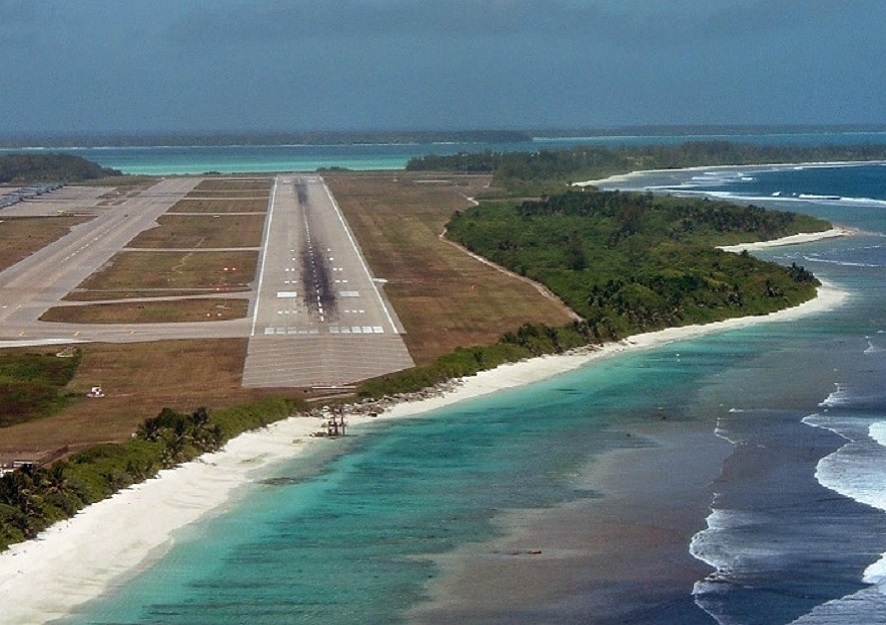
Located in the Indian Ocean, the Chagos Islands are comprised of seven atolls that are part of the British Commonwealth. The Chagos Islands are an English colony under the administration of the British Indian Ocean Territory. At least the islands were solidly an English colony until 2019 when the U.N.’s International Court of Justice (commonly referred to as the World Court) declared that Great Britain doesn’t have sovereignty over the islands. In 2021, the International Tribunal for the Law of the Sea upheld the ruling and ordered Britain to give the Chagos Islands back to the Republic of Mauritius, a nearby island nation that had won its independence from Great Britain in 1968. Why did the U.N.’s courts make this ruling? Well, two main things. Firstly, Mauritius is populated by Chagossians – from Chagos. Secondly, Great Britain expelled the Chagossians from the Chagos Islands in the late 60s and early 70s.
Before moving into why Great Britain sent an entire people group into exile, I want to briefly highlight the history of the Chagossians.
While used sporadically by the Portuguese as way stations for their trading exploits to India and China, the Chagos Islands weren’t claimed by a European colonizing power until1665 when the French decided God intended for them to have them. Prior to the Europeans “discovering” the islands, they were uninhabited although known about and utilized by fishermen from Madagascar.
The French established coconut oil plantations on the islands. Those plantations, of course, needed laborers. So, like all “good” Europeans of that day and age, they exported African slaves to the islands. The Chagossians are the descendants of those slaves. This brings us to the question: why did Great Britain exile the Chagossians? Well, because the United States of America asked them to.
You see, the Chagos Islands were deemed by the Pentagon to possess high military strategic value. An airbase on the islands places US bombers in quick range of a variety of potential enemies. Because of this, Great Britain forcibly removed the Chagossians from their homes and sent them into exile.
That’s a pretty cut-and-dried story. To be sure, I’ve ironed out the colorful, beautiful complexities of the Chagossian culture and skipped over a bunch of historical facts: like how the islands ended up passing from French hands to English hands. Those facts, those memories, while not unimportant, are not relevant for the historical narrative I’m attempting to shape. After this article’s conclusion, the reader will have to decide if the historical narrative introduced in this article is convincing or not.
For their part, defenders of the American exceptionalism historical narrative will undoubtedly argue that the security of the world takes precedent. “Many good people throughout history,” they’ll say, “have sacrificed much for the sake of liberty. The Chagossians should feel proud that their sacrifice is helping to protect the cause of liberty.” Irony will never die.
Here’s the point of my telling of the story of the exiled Chagossians: the liberties and luxuries that some of my readers and I enjoy are very real. Without question, the U.S. airbase on the Chagos Islands has played a role in ensuring the continuation of those liberties. But this means that the very luxuries that we enjoy have been at least partly paid for by the suffering and trauma inflicted on the exiled Chagossians. Our American exceptionalism has been bought with the stolen land of the Chagossians. That’s a historical narrative that’s hard for most Americans to swallow. Just because it’s hard to swallow, though, doesn’t mean it’s not true. The inconvenient history of the United States is far deeper and problematic than the majority of Americans realize. Shamefully, the story of the Chago Islands and the injustices the Chagossians have endured at the request of this country is just a drop in that historical narrative’s bucket. It’s deceitful and a violation of Kingdom (Christian) ethics to turn a blind eye to this historical narrative that challenges the belief in American exceptionalism.
[1] Michel-Rolph Trouillot, Silencing the Past: Power and the Production of History (Boston: Beacon Press, 1995), 15.
[2] Trouillot, Silencing the Past, 6.
[3] Mark Noll, America’s God: From Jonathan Edwards to Abraham Lincoln (New York: Oxford University Press, 2002), 38.
[4] John D. Wilsey, American Exceptionalism and Civil Religion: Reassessing the History of an Idea (Downers Grove, IL: IVP Academic, 2015), 19.
[5] Even the classification of them as the big three reveals a selective memory in service to specific historical narratives. What about the Indian Relocation Acts of the 1950s? Or the various Naturalization Acts denying Asians citizenship for the majority of this country’s existence? The Scotch-Irish stealing Indian nations’ land throughout Appalachia? The list of possible candidates for the “big three” goes on and on. The three I chose are easier to square with historical narratives that are framed to varying degrees by American exceptionalism. This is why it’s the three instances of injustice that could assume are already known by most people. If, for example, I had chosen America’s betrayal of the Hmong, I’m confident most readers would’ve fallen off the train of my thinking because most of them have never heard of America’s betrayal of the Hmong.
[6] Yes, so-called secularism has had a hand in the injustices, too. I’m not laying the entirety of America’s sins on the religious community. My point is that Wilsey’s warning is correct.
[7] This is technically the second article in this series. The first article tells of a children’s book about the Japanese internment camps during WWII. You can read it by clicking here.
 Practically Known Theology