by John Ellis
I met Patrick Buchanan in 1996. He was in Greenville, SC, wooing voters for his bid to become the Republican nominee for the presidential election later that year.[1] A friend and fellow student at Bob Jones University had scored an invitation to a private reception for the paleoconservative stalwart. I tagged along. Not having been impressed with the man before I went, I was even less impressed upon meeting him. Over the years my opinion of Pat Buchanan has continued to sink as I’ve read his books and listened to more of his speeches.
I’m currently reading Buchanan’s 2002 book The Death of the West, which isn’t elevating my opinion of the man; the exact opposite, in fact.[2] The book is explicitly based on the replacement theory[3], is misogynistic, and relies heavily on strawmen throughout to make its case. In some instances, Buchanan blatantly embraces historical shell games that are deceitful. One of these historical shell games is rampant throughout much of white evangelicalism (and the Republican party/so-called conservatism in general): the assertion that Africa shares some responsibility for the Transatlantic slave trade.
I want to home in as quickly as possible on my thesis – claiming that Africa shares some responsibility for the Transatlantic slave trade is historically deceptive (and racist) – but a little brush clearing regarding Buchanan’s book is in order. His claims that I want to focus on for the next couple of paragraphs sit smugly in chapter 3 “Catechism of a Revolution.”
What is Mr. Buchanan’s revolution? In his words, “We are two countries, two peoples. An older America is passing away, and a new America is coming into its own.”[4] While I won’t argue against that point because it’s correct on its surface, there is an insidious evil tightly tucked into the subtext of his point. Buchanan’s thesis is dependent on the belief – a belief he pushes throughout his book – that Western, white culture is superior to all others. He argues, “Leaders who wish to preserve their unique national identity and character are branded as racists and xenophobes.”[5] In other words, and remembering that he believes Western, white culture is the superior culture, those who seek to usher in this “new America” have unjustly and incorrectly labeled the wrong people the bad guys in history. For Buchanan, as well as most white evangelicals, Western, white culture is the tip of God’s spear for spreading the Kingdom. This is a centuries old belief. Born with the Doctrine of Discovery established by Pope Alexander VI’s papal bull Inter Caetera that was issued in May 1493, manifest destiny/city on a hill type imagery, language, and beliefs are inseparable from the worldview of much of white evangelicalism.
The Doctrine of Discovery’s main objective was to ward off conflict in Europe. The Pope wanted to equitably divvy up the “newly discovered” lands across the Atlantic as well as the African continent that Portugal was already plundering. During the following century, nations like England, France, and Holland were able to fold themselves into the Doctrine of Discovery. But while its objective was mainly to help prevent conflict among the European powers, the heart of the Doctrine of Discovery was the belief that Western culture is a God ordained reflection of the Kingdom and, hence, superior to all others. Ingrained into it was the call that European nations had a duty before God to colonize pagan lands and force their culture on the “inferior” people groups.[6] As Robert P. Jones dryly observed, “The Doctrine of Discovery, in short, merged the interests of European imperialism, including the African slave trade, with Christian missionary zeal.”[7]
Patrick Buchanan zealously, to borrow Robert P. Jones’ term, embraces the heart of the Doctrine of Discovery which prevents him from seeing the irony in his complaint that the “revolution” is in the process of dethroning the Western, white culture in this country while labeling those who resist as racist. You see, Buchanan has zero issue with some cultures overthrowing and subjugating other cultures so long as the aggressors are Western and white, and the people groups being subjugated are not. As a general rule, I’m a fan of irony but not in this instance.
I admit that there is still quite a bit of unpacking needed for those who agree, to some degree or other, with Buchanan that the Western, white culture is superior and is, even if only partially, a Christian culture ordained and sanctioned by God. I’m also aware that my response (which I’m about to get to) in this article to a specific historical shell game played by Pat Buchanan will likely fail to change the mind of those who do agree, to some degree or other, with Buchanan’s overall belief in the superiority and theological sanctioning of Western, white culture. My hope is that my arguments will serve to begin cracking the epistemological shield protecting the Western, white-centric worldview held by the majority of white evangelicals. And my thesis and arguments are in response to this quote from The Death of the West: “Why else would Mr. Clinton have traveled to Africa to apologize for slavery to the heirs of the tribal chiefs who captured and sold the slaves? Slavery existed even before Arkansas. And the West did not invent slavery; the West ended slavery.”[8]
The sentiment residing in Buchanan’s rhetorical question that begins the above quote is obvious: the United States of America doesn’t need to apologize for slavery because Africa shares in the responsibility for it. The pride dripping from the quote’s final sentence is equally apparent: the West – including the United States – ended the scourge of slavery, a scourge, that they didn’t start. If nothing else, the quote demands, the descendants of slaves owe those of us who are white Westerners a thank you.
This is a racist sentiment believed widely among white evangelicals and Republicans, including Buchanan. It’s usually expressed in some version of, “True, slavery was bad but look how much better off Black people are here in America as opposed to if they were still in Africa.”[9] This belief should be self-evidently bad/wrong/racist, even on its surface. Chattel slavery is evil, full stop. That’s all that needs to be said. Digging into the statement even further exposes a near total ignorance of what white Westerners did to the African continent. In 2023, Africa is a diverse, beautiful place. Cultures are thriving and flourishing. But there is also much misery and oppression. And that misery and oppression can be directly traced back to the imperialistic actions of the West. Europe (and America) plundered her. Blaming Africa for the current conditions that plague her is like breaking into your neighbor’s house, stealing all their food, and then clucking your tongue because they were unable to feed their kids dinner. For those interested, I encourage the exploration of Afrofuturism. Chances are most people have already been made aware of the philosophy via the fictionalized (with a sci/fi bent) Black Panther movies. In brief, Afrofuturism envisions how the African continent would’ve progressed if white people hadn’t broken into their house and stolen everything, including their children. Slavery, alongside colonization, decimated Africa. That is a central (and sinful) part of the West’s legacy. And while the West didn’t technically invent slavery, Patrick Buchanan is playing a shell game. While demanding that his readers pay attention to an ironed-out definition of slavery lacking in historical nuance, he’s keeping the truth hidden that Western chattel slavery was a dramatically different type of slavery.
It’s true that throughout most of human history some form of slavery was the condition under which many people lived. In that sense, Buchanan is correct that the West did not invent slavery. But’s there’s a sharply ironic deceit in his claim.[10] As anyone versed in Christian apologetics knows, the short answer to challenges about the Bible’s apparent condoning of slavery is, “Slavery in the ancient world was different than the chattel slavery fed by the Transatlantic slave trade starting in the 15th century and enduring well into the 19th century.” No doubt – and I do mean NO doubt – many of those reading this who nod in agreement to Buchanan’s quote have utilized the Christian apologetic distinction between ancient slavery and the chattel slavery practiced in this country’s past. Hopefully, as they read those last few sentences, their unintentional irony is not completely lost on them. For those readers who are not versed in the Christian apologetic response that undermines Buchanan’s quote, I offer a brief and incomplete description of the distinctions between types of slavery practiced around the world throughout history in the next few paragraphs.
The history of slavery is equal parts disturbing and fascinating. Across ages and nations, it was a varied practice with regional nuances that make thin treatments of it challenging and reductionistic claims about it woefully inept at capturing its scope and diversity, and that applies to this article. By no means am I attempting a full-throated academic articulation of the various forms of slavery throughout history nor am I attempting to draw out all the distinctions between the chattel slavery created and propagated by the West and the various iterations of slavery that have existed around the world. My goal is merely to open the historical door so that readers can peer in and see for themselves that differences exist, and differences to the degree that sharing the same word “slavery” is hard to justify at times, most notably between the chattel slavery practiced in the “new world” and the slavery practiced around the world throughout history.
Narrowing the focus into medieval Europe, historians and anthropologists continue to puzzle over the distinction between slave and serf. Both categories used the same Latin term – servi – and even those instances when it seems apparent that slave is the correct term, the slaves had personal, civil, and property rights that the chattel slaves in this country were never even allowed to sniff. Neither category of medieval slave or serf fits well within the narrative and definitions that arose out of the chattel slavery that dominates 21st century discussions. Peering into history even further, and slavery under Roman law was vastly different from the slavery suffered by enslaved Africans and their descendants throughout the “new” world. But it had its own cruel oddities.
Roman slavery evolved as the Republic gave way to the Empire. During the Roman Republic, the slave owner held absolute power over his slaves, even to the point of death.[11] This was morally justifiable to Romans because slavery was a form of death. Slaves were those who had forfeited their life either through warfare (being a prisoner of war) or a crime. That began to change, though, in 16 A.D. when Emperor Tiberius issued a decree requiring slave owners to receive permission from the local magistrate before killing a slave. By the 2nd century, under the influence of the Stoics, especially the Stoic Epictetus who had once been a slave himself, Roman law began legislating slavery into a form that is almost indistinguishable from the European serfdom of the Middle Ages. Anthropologist David Graeber draws out an important distinction between Roman slavery and the chattel slavery practiced in America. He writes, “In dramatic contrast with, say, plantation slavery in the Americas, there was no sense that certain people were naturally inferior and therefore destined to be slaves. Instead, [for the Romans] slavery was seen as a misfortune that could happen to anyone.”[12]
Throughout the evolution of slavery in the Roman world, slavery was a consequence of something you did or did not do, not a consequence of who you were. You were enslaved because you had done something or failed to do something that rendered you deserving of enslavement within that society’s code of ethics and judicial system. In America and the West, post-15th century slavery was a product of who you were – your ethnicity. Chattel slavery in the “new” world was ontological and not ethical/legal[13] (I’m not using ethical in the sense of “morally justified” but in the sense of a product of actions).
In the Muslim world, slavery was considered an integral part of society. But, as the esteemed British historian Hugh Thomas points out, slavery in Islam was “more benign” than slavery across the Roman world.[14] Besides the various laws protecting the rights of slaves, it was possible for slaves to climb to positions of power, riches, and prestige, all while still technically being a slave. Slavery was also an equal opportunity station in life. Beside the many Christian Spaniards and Scandinavians enslaved by Muslims, “in the early Middle Ages, at all the Muslim Mediterranean courts … there were gathered together, as in an international brigade of servitude, Greek, Slav, German, Russian, Sudanese, and black slaves.”[15]
Slavery was also found across the African continent. Like the rest of the world, two main types of slavery existed in Africa: one type is more correctly labeled serfdom and another a system populated by prisoners of war and criminals. Under Muslim influence, especially in the Muslim nation of Songhai, the slave trade peaked during the Middle Ages. Wowed by the fighting prowess of African warriors, Muslim princes coveted African slaves for military purposes. Black slaves were highly valued not only across the Muslim world but also in the courts of India and China. Unlike those trapped in the chattel slavery of the “new” world, Black slaves in India and China were highly valued because they were viewed as treasures – as works of art even – and not as inferior beings to be used up and spat out. I’m going to include a paragraph lengthy quote from Joseph E. Harris’ universally esteemed book Africans and Their History because his summation of African slavery is succinct, historically rich, and speaks to my point better than I can:
“The question of traditional servitude in Africa is often raised in connection with the development of the overseas slave trade. It should be noted at the outset that much of Africa resembled a feudal society with rulers, vassals, and subjects. Although vassals were free men, they owed services and tribute to their ruler who provided general protection and helped to resolve various kinds of disputes. Vassals in turn provided protection for their subjects in exchange for labor and goods. Societies were essentially communal and stratified, with no one working for money, but virtually everyone provided duties individually or collectively to someone else. Even so, there was domestic slavery as well as other classes of people with virtually no freedom: community outcasts, adulterers, debtors, prisoners of war, and persons convicted of witchcraft. These persons had few rights which rulers or societies were obliged to observe. But, with these few exceptions, slaves were regarded as human beings and not chattel. They could marry, own property, maintain their family unity, freely worship their god, and sometimes they became military commanders and even rulers. This kind of servitude, therefore, should not be confused with American slavery in which the slave was regarded as chattel, and defined as property and real estate.”[16]
A quick survey of the history of slavery reveals that our modern definition of slavery is at odds with how slavery has historically been viewed and practiced. For those of us living in the 21st century West, the word slavery conjures up images of chattel slavery on cotton plantations in the antebellum Deep South. Those images are at odds with the various types of slavery practiced throughout the world prior to the Transatlantic slave trade.
It’s hard to see enough of a parallel between ancient and Medieval slavery practiced around the world and the chattel slavery found in the southeastern states of America from 1619-1863 to warrant the absolute assertion that the West did not invent slavery.[17] While it’s technically true that the West did not invent slavery, it’s deceitful to make that claim without acknowledging that the West did create a new kind of chattel slavery system that was utilized in the “new” world. Buchanan’s statement is a shell-game that’s accepted by people who wouldn’t accept the same shell-game if played by those seeking to discredit Christianity because of the Bible’s perceived condoning of slavery.
The version of slavery – chattel slavery – unleashed on the world’s stage by the West embraced levels of wickedness rarely seen in world history. It’s historically deceitful for Patrick Buchanan, and others, to proudly declare that the West did not invent slavery without acknowledging the drastic differences between the slavery practiced in the “new” world and the slavery practiced throughout the rest of the world down through history. An honest statement would look like this: While the West did not invent slavery, they found a way to make slavery even more terrible and sinful.
But what about Buchanan’s argument that Africa shares in the responsibility for the Transatlantic slave trade?
Making Buchanan’s argument is like arguing that the Cherokee Nation bears some responsibility for the Trail of Tears. I’ll unpack that shortly, but some historical background to the Transatlantic slave trade is in order first.
Portugal didn’t show up in Africa with the intention of colonizing nor enslaving her people, that’s true. Their original concern was finding trade routes to India and China. However, the Portuguese traders quickly recognized the incredible riches held by the African continent. Establishing mini-colonies along the coasts of Africa for their trade ships to dock and restock along the coasts quickly morphed into Portuguese merchants procuring/stealing gold and silver mines.[18]
This, in turn, created a need for cheap labor to dig all that gold and silver out of the earth. Fed by greed for material goods and lust for power, the enslavement of Africans by Westerners was kicked into high gear. Morphing from the earlier versions of slavery that viewed Africans as exotic and prizes to be showed off in the European courts (that is still wrong, to be clear), Africans began being viewed by Europe as a cheap source of labor.
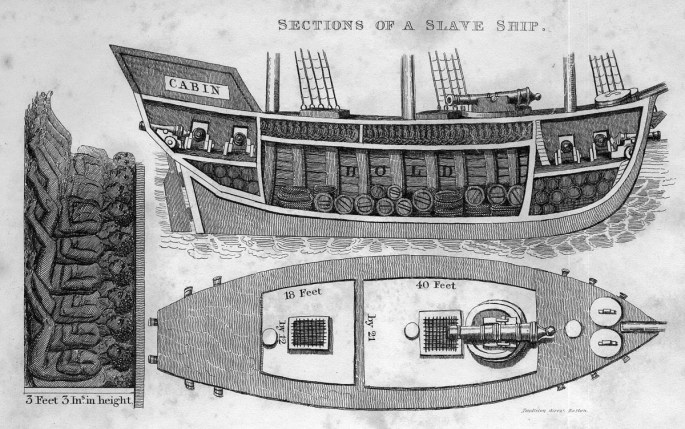
It didn’t take long for other European powers to begin take note of the success of the Portuguese merchants. This is why explorers turned their eyes west, across the Atlantic. Same song and almost same verse: the gold and silver that Europe desperately coveted (see footnote #18) was found in abundance in the “new” world. Again, cheap labor was needed. The indigenous people of the “new” world died en masse, though, unable to withstand the scourge of European diseases that literally swept through South and then Central America, even making its way into North America. Indian nations in North America were wiped out by the European’s diseases before they had even encountered any Europeans. Unable to depend on the indigenous population for a steady, consistent stream of labor, the Europeans turned their greedy gaze back to Africa and her people. Chattel slavery and the Transatlantic slave trade was born.
Okay, John, but what about the fact that Africans participated in the slave trade? Well, as I wrote above, that’s like saying that the Cherokee nation shares responsibility for the Trail of Tears. After a brief look at the history of the Cherokee nation and the Trail of Tears, I’m going to circle back to the Transatlantic slave trade and Africa.
In 1791, the United States government signed the Treaty of Holston with the Cherokee Nation as a means to draw to a close the lengthy Cherokee-American Wars. Led by the leader John Watts (Young Tassel), the Cherokee Nation agreed to place themselves under the protection of the fledgling United States of America. I’m not going to state all the terms of the treaty, but the important points for this article’s objective are: the borders between the Cherokees and America were drawn and established in perpetuity; any Americans who settled on Cherokee land were subject to punishment by the Cherokee Nation (Americans weren’t even allowed to hunt on Cherokee lands); the United States promised to never annex Cherokee lands. Well, and there’s a common historical theme here, the Treaty of Holston was signed before the invention of the cotton gin and the discovery of gold in the hills of Georgia. After those two things, Cherokee land became quite valuable and attractive to greedy white Americans.
The resentment of white Americans to the holding of valuable lands by Indian Nations (it wasn’t just the Cherokees) resulted in the infamous Indian Removal Act signed into law by President Andrew Jackson on May 28, 1830. According to the Act, Indian nations[19] would be provided land west of the Mississippi River. Land that the United States believed lacked value, exposing a common historical theme once again.[20] Keeping the focus on the Cherokees, though, and the Cherokee Nation declined the United States’ “offer.” Their refusal to submit to the will of the white race and their superior culture (Pat Buchanan didn’t invent it, as I said) had already enraged the white people of Georgia. After Jackson was elected to the White House in 1828, the Georgia legislature responded to the Cherokee Nation’s stubborn refusal to bow to the will of white people by passing draconian laws that disenfranchised the Cherokee people in an attempt to make their lives miserable enough where they’d pack up and move west all on their own. Two lawsuits landed on the Supreme Courts docket in the early 1830s. In the second of the cases, Worcester v Georgia, the US Supreme Court ruled that the State of Georgia’s laws aimed at the Cherokees were unconstitutional because the Treaty of Holston placed the Cherokees under the jurisdiction of the federal government and not the state. This ruling gave rise to the apocryphal pronouncement from Andrew Jackson: “Chief Justice John Marshall has made his decision; now let him enforce it.” There is zero evidence that Jackson ever said that, but the sentiment was definitely apparent in his response. The U.S. government refused to enforce the Supreme Court’s ruling, leaving Georgia free to deal with the “stubborn, rebellious” Cherokees as they saw fit.
As white Georgians began invading and stealing Cherokee lands under the unofficial protection of the federal government, a small minority of Cherokees believed they saw the handwriting on the wall. Called the “Treaty Party,” this group of Cherokees took it upon themselves to negotiate with the US government. Never mind that the Cherokee Nation didn’t ask them to do that, didn’t want them to do that, nor gave them the authority to speak on the Nation’s behalf. Led by John Ridge (Skah-tle-loh-skee, or Yellow Bird), the Treaty Party agreed to terms with the federal government. The terms of the treaty included the removal (either voluntarily or forced) of the Cherokees to lands in Oklahoma. In return, the United States agreed to pay the Cherokees five-million dollars, a sum several million dollars below the market value of the land.[21] Signed in 1835, this treaty is named the Treaty of New Echota.
Immediately, the Cherokee Nation protested. Led by Principal Chief John Ross (Guwisguwi, or Mysterious Little White Bird), a delegation of Cherokees traveled to Washington, D.C. and implored Congress to recognize that the Treaty of New Echota was invalid. Their appeals were to no avail. Motivated by greed, Congress sided with the unofficial, unsanctioned Treaty Party. Principal Chief John Ross then made the hard decision to encourage his people to voluntarily move to Oklahoma. He understood that if they tried to stand up to the might of the U.S. Army, the Cherokee Nation would suffer greatly, including many deaths. To be fair, he didn’t have the ability to foresee that the U.S. government would immediately violate the part of the Treaty of New Echota that provided support for the Cherokees in their move west – hence the name Trail of Tears.[22]
Here’s my point, if it’s not obvious: Laying any of the responsibility for the Trail of Tears at the feet of the Cherokee Nation because of the actions of the Treaty Party is historically deceptive and racist.[23] And my argument’s logic applies to Africa and the Transatlantic slave trade.
Buchanan’s specific shell game here is convincing people to keep their eyes on the fact that some Africans did aid the Europeans in the enslavement of other Africans. The question is, though, were the actions of those Africans indicative of the overall sentiment, desires, and actions of Africa? Or, like the Treaty Party comprised of Cherokees acting in bad faith, were those Africans who participated in the Transatlantic slave trade simply bad actors who were motivated by greed to violate their community beliefs, ethics, and laws?
Even the African historian Harris acknowledges, “The [Transatlantic] slave trade eventually led some African political and religious authorities to abuse traditional practices in order to secure slaves.”[24] Harris makes it clear, though, that the number of bad actors in Africa who provided European slave traders with their fellow Africans were not only a minority but were in blatant violation of African customs, laws, and religious dictates.
Africa did not create the chattel slavery that fed the Transatlantic slave trade. Africa did not provide the consumer desires that “required” the product called chattel slavery. Nor did Africa fund the enterprise. It’s true that some Africans personally benefitted from the Transatlantic slave trade, but they were a minority acting in opposition to their communities and nations. It’s historically deceptive (and racist) to insist that Africa shares blame with the West for chattel slavery.
This leads to one final point: do modern Americans share guilt with those engaged in the Transatlantic slave trade and chattels slavery on these shores? In a word, no.
One of the (many) lies told by the anti-CRT crowd is that CRT teaches white people to feel guilty. That is absolutely false. CRT teaches the exact opposite. I am not guilty for chattel slavery, and feeling guilty is ultimately self-serving. What CRT calls white people to do is to recognize how our nation has been created by systems of oppression, including chattel slavery. With that knowledge, CRT then asks us (white people) to seek to undo the historical legacy of oppression still born by people of color, including Indigenous peoples.
The power, prestige, and riches of the United States of America didn’t appear out of thin air.[25] The comforts, so-called freedoms, and privileges that many of us enjoy have been produced by settler-colonialism and chattel slavery. This nation’s great infrastructures – including the banking and finance sectors, railroads, and steel industries – are the direct results of the egregious sins of the founders and builders of this country. Without settler colonialism and chattel slavery, the United States of America would not (could not) enjoy her current position of power and wealth. As a white person, my privileges owe a debt to settler colonialism and chattel slavery. Again, though, I hold no guilt for past sins committed by people I’ve never met. I do bear a responsibility for what I do with my privileges. Am I seeking to serve, empower, and center historically marginalized and oppressed communities? Or, like the predominant response in white evangelicalism, am I seeking to preserve my privileges even if it means the continued marginalization and oppression of others?
The answers to those questions are provided unequivocal answers by Kingdom ethics. Sadly, by and large, white evangelicals worship the American Dream and not Jesus. This is evident in Patrick Buchanan’s book and it’s evident in white evangelical’s contemporary responses to systemic injustices, racism, and CRT. Placing a share of the blame for the Transatlantic slave trade on Africa is one piece of evidence of this. White evangelicals need to repent of their idols of Western culture and worldview and turn to Jesus before it’s too late.
Soli Deo Gloria
[1] I don’t remember hearing him speak on BJU’s campus. I couldn’t find any record of it online. He did speak at BJU in 2000, but I wasn’t there by then. I do remember hearing Bob Dole and Dan Quayle speak from the FMA stage during the 96 primary, though. Buchanan is a devout Roman Catholic and the famously anti-Catholic Bob Jones, Jr. was still alive in 1996. In 2000, when Buchanan spoke at BJU, Jr. had been dead for 3 years. Maybe Jr. still being alive in 96 is what prevented Buchanan from speaking to the BJU student body (assuming he didn’t speak, and I’m simply not remembering it because I skipped it, which is also a possibility). I don’t know. I’m just guessing here, which is why this is in a footnote and not included in the body of the article.
[2] Why am I reading it?, you ask. 1. As Sun Tzu taught, know thine enemy. 2. I want to do my best to not strawman my ideological opponents.
[3] I mean, it’s in the subtitle of the book: How Dying Populations and Immigrant Invasions Imperil Our Country and Civilization.
[4] Patrick Buchanan, The Death of the West: How Dying Populations and Immigrant Invasions Imperil Our Country and Civilization (New York: Thomas Dunne Books, 2002), 6.
[5] Buchanan, The Death of the West, 209.
[6] The European invaders/colonizers had a speech they would read to the Indigenous peoples. It stated that they were now under the authority and protection (HA!) of the Christian Europeans who had so mercifully and graciously discovered the land they were all standing on. The speech explained that if the Indigenous people failed to submit to their new benevolent (HA!) masters, then they would be killed. The speech was usually delivered in Latin. I’ll leave it to the readers to determine if the Indigenous people even understood what was being dictated to them, much less the morality of the statement and statement’s sentiment. Hubris, thy name is the West.
[7] Robert P. Jones, The Hidden Roots of White Supremacy and the Path to a Shared American Future (New York: Simon & Schuster, 2023), 15.
[8] Buchanan, The Death of the West, 58.
[9] They don’t capitalize Black, of course, because that’s considered woke.
[10] It’s also objectively untrue since slavery still exists in this world. Often in service to the consumer needs of those of us living in the good old U.S. of A.
[11] The right for early Romans to kill their slave at will is unusual in history. It’s practically a one-off.
[12] David Graeber, Debt: The First 5,000 Years (London: Melville House, 2014), 202.
[13] The legal aspect arose out of the bigoted belief that Blacks were ontologically fitted to be enslaved, not the other way around. This is what CRT is getting at with the claim that racism is systemic.
[14] Hugh Thomas, The Slave Trade: The Story of the Atlantic Slave Trade 1440-1870 (New York: Simon & Schuster Paperback, 1997), 37.
[15] Thomas, The Slave Trade, 38.
[16] Josephy E. Harris, Africans and Their History (New York: Mentor, 1987), 81.
[17] I want to acknowledge that chattel slavery existed in the Caribbean islands and parts of Central and South America, too. My audience for this article is primarily white evangelicals.
[18] China, especially, demanded gold and silver for all their commodity goods that Europeans craved. Unfortunately for Europeans, gold and silver were in short supply in Europe by the 14th century. The gold and silver mines of Africa proved too much of a temptation for the power and riches hungry Europe to resist. So, they stole them. First in Africa and then in the “new” world. As I write in the body of the article above, the need for cheap labor to get all that gold and silver out of the earth was initially what created chattel slavery. Greed, both for material goods and prestige and power, was (is) the motivation for the West forcing itself and its “worldview”/culture on the rest of the world.
[19] As an important sidenote: using the words Indian nation instead of Indian tribe acknowledges their sovereignty and highlights the sins committed against them by the United States.
[20] Also, guess what happened once Americans decided that the land promised in perpetuity to Indian nations was, in fact, valuable. Yep. You got it. This is also why the pejorative “Indian giver” is not only racist but a laughable lie – well, laughable if the events behind it weren’t so devastatingly consequential.
[21] Not to mention that the $5 million was never fully paid. Like most of the treaties signed by Indian nations, the money was dispersed by corrupt Indian agents (white people, to be clear – Indian agent was their job title). Often, including in the case of the Cherokees, the Indian agents determined that the Indians were too childlike (read: stupid) to handle money, so they used the money to buy food to be dispersed among the people. Except, the agents would buy food stuffs from their friends at incredibly inflated costs, not to mention the service and the administration fees that agents took for themselves and their staffs. Sometimes, the Indian agents didn’t even bother with that pretense; they just pocketed the money. See the events that led to the Dakota War of 1862 in Minnesota. After being told that Dakota women and children were dying from starvation, Indian agent Andrew Myrick responded with, “If they are hungry, they can eat grass.” He continued to refuse to provide food to the Dakotas (he refused to do his job, in other words).
[22] It’s actually Trails of Tears since various Indian nations suffered the same fate.
[23] Racist in the CRT sense that racism is systemic and doesn’t require personal bigotry.
[24] Harris, Africans and Their History, 90.
[25] Western capitalism succeeded because it cheated.
 Practically Known Theology