by John Ellis
The signing of the Armistice on November 11, 1918, may have officially ended the military battles of World War I, but the fighting was far from over. The carnage, suffering, and demolished infrastructures left in the war’s wake bred resentment and anger. Pounds of flesh would be demanded over the coming months and years. Furthermore, upon the war’s conclusion three of the world’s longstanding empires had collapsed and a fourth was helplessly teetering. With the dissolution of the Habsburg, Hohenzollern, and Romanov empires, along with the imminent end of the Ottoman Empire in everyone’s sightline, the lust for more land grew in the remaining colonial powers of Western Europe. The new power on the world’s scene, America, was led by a self-righteous prophet of peace who eschewed colonization, but he was swimming in diplomatic waters that were way over his head. All that anger, lust (for both land and power), and self-righteousness converged on Paris in January 1919 resulting in a clash of wills and competing interests that would remake the world, and not for the better.
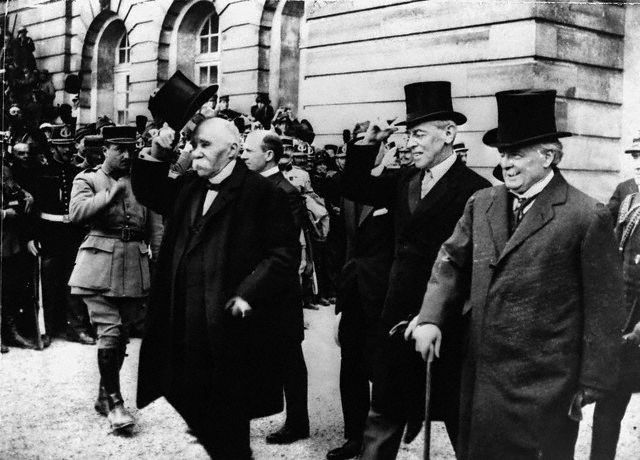
Historian Michael Neiberg points out the obvious that, “The process of peacemaking lasted longer than the First World War it endeavored to end.”[1] That process started with the Paris Peace Conference on January 18, 1919, and didn’t officially end until the signing of the Treaty of Lausanne on July 24, 1923. But for six months in 1919, the eyes of a war-weary world gazed hopefully at Paris. Led by the big three – United States President Woodrow Wilson, English Prime Minster David Lloyd George, and French Prime Minister Georges Clemenceau[2] – the victorious Allies began to determine the fate of much of the globe’s future.
Also in Paris for the momentous event was British Foreign Minister Arthur Balfour, the namesake for the Declaration that pledged England’s support for the Zionist project. From his front-row seat, he watched Woodrow Wilson, David Lloyd-George, and Georges Clemenceau fumble through the business of remaking the world, relying heavily on the young British diplomat Harold Nicolson for guidance and advice. During discussions over how to remake Turkey, the normally unflappable Foreign Minister angrily quipped, “I have three all-powerful, all-ignorant men sitting there and portioning continents with only a child to take notes for them.”[3] For his part, Nicolson was acutely self-aware of what was happening, echoing Balfour’s words by writing in his diary, “It is appalling that these ignorant and irresponsible men should be cutting Asia Minor to bits as if they were dividing a cake. Isn’t it terrible, the happiness of millions being discarded in that way? Their decisions are immoral and impracticable. … These three ignorant men with a child to lead them. The child, I suppose, is me. Anyhow, it is an anxious child.”[4] Nicolson had reason to be anxious. It’s not hyperbole to state that many, if not most, of the world’s current geopolitical problems have their genesis in the decisions made over the course of those six months in Paris.
The short buildup to the Paris Peace Conference provided hope, though. For those like the Vietnamese, Turks, Kurds, Poles, and the various other nations and people groups who had suffered under colonialism and empire building for generations, an esteemed, powerful advocate and potential savior emerged: President Woodrow Wilson. His calls for national self-determination were heard as a welcoming harbinger of independence. Sadly, Wilson’s own bigotries and inadequacies as a diplomat torpedoed the hopes of people groups and nations who had been subjugated by Austria, Germany, Russia, and the Ottoman Empire. Ultimately, “Self-determination was traded away in a vain effort to salvage Wilson’s precious League of Nations.”[5] Getting to that point, though, is a story unto itself, and a story I can only engage in part.[6]
Woodrow Wilson should occupy an honorific position in the hearts of contemporary Democrats, similar to that as Calvin Coolidge does in Republican hearts.[7] A staunch liberal, Wilson was an ardent advocate for progressive causes, bringing about many of the changes held dear by Democrats and loathed by Republicans. His appointment of the progressive associate justices Louis Brandeis and John Hessin Clark to the Supreme Court helped serve as a speedbump to the highly conservative Court of the 1920s led by ex-President turned Chief Justice William Howard Taft. The minority decisions of Taft’s Court helped lay the foundation for the decisions handed down by the progressive Courts of the mid-20th century.[8] But Wilson was also an inveterate and unabashed bigot. While his racism didn’t stop him from arguing for national self-determination leading up to the Paris Peace Conference, his bigotries did play a role in his willingness to trade the fates of people of color in attempts to salvage the birth of the League of Nations. Prior to the Peace Conference, though, the many people groups around the world longing for self-governance only heard Wilson champion their right for self-determination.
On January 18, 1918, President Wilson stood before a joint session of Congress and delivered what is known as the “14 Points Speech.” In it, he laid out the 14 Points that he hoped would serve as the foundation for his desired League of Nations and the basis for any forthcoming peace treaties after the war. With Point XIV, Wilson insisted, “A general association of nations must be formed under specific covenants for the purpose of affording mutual guarantees of political independence and territorial integrity to great and small states alike.”[9] Expounding on Point XIV in a follow up speech delivered to Congress on February 11, Wilson went on to declare, “People are not to be handed about from one sovereignty to another by an international conference. … National aspirations must be respected; peoples may now be dominated and governed by their own consent. … Self-determination is not a mere phrase. It is an imperative principle of action, which statesmen will henceforth ignore at their peril.”[10]
The European leaders held at least some level of resentment of Wilson. Margaret MacMillan reveals that Lloyd George said of the US President that “He came to the Peace Conference … like a missionary to rescue the heathen Europeans with his ‘little sermonettes.’”[11] With an obvious eyeroll, Clemenceau complained, “God was satisfied with Ten Commandments. Wilson gives us fourteen.”[12] Lloyd George and Clemenceau took advantage of Wilson’s political inexperience as well as his prolonged absence during his return to the United States in the middle of the Peace Conference. While away, Wilson’s righthand man, Colonel House, renegotiated away much of the gains Wilson thought he had achieved prior to his departure. The end result looked little like Wilson’s dream of national self-determination for small nations and colonized people groups.
The sniping, backdoor dealings, and manipulation of Wilson by more skilled diplomats weren’t the initial obstacles to the President’s desire for national self-determination, though. The Sykes-Picot Agreement, which Colonel House described as “all bad … They are making it a breeding place for future war”[13], embarrassed the President and served as a barrier to his objectives. Wilson wasn’t the only one dismayed by the agreement, though. Both the pan-Arabists and Zionists were mortified when they discovered England’s double-dealing.
Sir Mark Sykes and Francois Georges Picot met in London on December 21, 1915, to begin discussing “an agreement that was to prove an enormous stumbling block for those in Paris three years later who sought to do the right thing in the Middle East.”[14] Continuing the discussion between the two countries that had started on November 23, Sykes and Picot were both intimately knowledgeable of the Middle East, and they worked quickly. Needing French backing for any potential invasions of the Ottoman Empire, England dangled Syria and Lebanon in front of France. Of course, both Czarist Russia and Italy had to be kept happy, too. Pieces of the Middle East were carved up and passed back and forth across the London table. The talks were wrapped up on January 3, 1916; the Sykes-Picot Agreement was ratified by all parties, except, of course, by the actual people groups involved who didn’t know the negotiations were happening, by May.
England was given control over Mesopotamia – much of what is now known as Iraq. With France promised Lebanon and much of Syria, the question of Palestine was “a thorny issue because of the intense interest of other Christian powers (Russia in particular).”[15] After some wrangling, Italy was awarded Asia Minor in 1917. As her reward, Russia was promised Constantinople, a city they had long desired since the reign of Ivan the Great. Russia also received the Turkish Straits and Western Armenia. As Margaret MacMillan surmises, “The Arabian peninsula was not mentioned, presumably because no one thought all those miles of sand worth worrying about.”[16] The European colonial powers had decided the fates of millions of people without ever bothering to consult them about their wishes.
In chapter 2 (part 1) of this series, the McMahon-Hussein correspondence was discussed. In October 2015, the British government promised Sharif Hussein most of the land that the Sykes-Picot Agreement distributed among the Allies. Aware of French plans for the region and England’s strategic need to placate their ally, McMahon kicked the can of Syria down the road, leaving the two agreements standing in direct contradiction to each other. Believing that England was going to support the creation of an Arab state that stretched across Lebanon, Palestine, the Arabian Peninsula, Mesopotamia, and possibly Syria, the Sharif and his sons risked their lives to wage a revolt against the Young Turks. As Barabara Tuchman sharply points out, “[the Sykes-Picot Agreement’s] terms, no matter how you stretch them, cannot be made to fit the pledge made to the Arabs.”[17]
Not long after the conclusion of the agreement bearing his name, Sir Mark Sykes converted to the Zionist cause. He became a powerful ally, with Tuchman claiming, “Whatever obstacle reared up to block the path – French claims or Vatican frowns or internal Zionist stresses – Sykes knew what wire to pull to clear the way.”[18] But the Sykes-Picot Agreement was still an obstacle for the Zionists, they just didn’t realize to what extent.
On February 7, 1917, Sir Sykes met once again with a group of Zionist leaders, including Chaim Weizmann, Harry Sacher, and Ahad Ahem (Ha’Am). The Zionists stated their belief that their interests were best served if the proposed Jewish state – Palestine – was under the protection of a British protectorate. They feared any French control because France tended to expect her colonies to become French via the erasure of national identities.[19] For them, a joint British-French protectorate would also be unworkable because the two European powers would be pulling in different directions and the Jewish settlers would suffer as a result. However, “They did not realize that a year previously Sykes and Picot had agreed precisely to international control of Palestine as a whole.”[20]
Unbeknownst to the Zionists, a third party was involved in the geopolitical tug-of-war over Palestine, too. “No one at the meeting except Sykes knew of the McMahon-Hussein correspondence or that Arabs might believe Palestine had been promised to them.”[21] As more and more of England’s double-dealing became exposed, Harry Sacher argued to his receptive fellow Zionist leaders of the importance “of obtaining from the British government ‘a written definite promise satisfactory to ourselves with regard to Palestine.’”[22]
Another important party – the United States – had yet to weigh in. Congress officially declared war on Germany on April 6, 1917. On May 18, British Foreign Secretary Arthur Balfour sent the White House a copy of the Sykes-Picot Agreement. No matter how hard President Wilson pushed, “The Allies would not renounce the claims that they had staked out for themselves in their secret agreements.”[23] Because of this, Woodrow Wilson found himself in a quandary. Having publicly denounced secret treaties, he was also aware that if the Sykes-Picot Agreement was made public, the war effort could be negatively affected. The Allies desire for secrecy was upended, though, after Lenin and Trotsky led the Bolsheviks to power in Russia. With the goal of embarrassing the Western nations, as well as to weaken their position, on November 23, 1917, Lenin released to the world the text of the previously secret Sykes-Picot Agreement. According to David Fromkin, “Wilson tried – but failed – to prevent the publication of the treaties in the United States.”[24]
With the release of the Sykes-Picot Agreement, and foreshadowing a dominant theme of the Cold War, Lenin set his version of Marxism in contrast to the colonial greed of the Allies. Wilson had worried “that the Bolsheviks might present a viable alternative to his own anti-colonial ideals.”[25] Sure enough, “People across the globe saw the hypocrisy of British and French actions in the Middle East and took notice.”[26] But the President wasn’t going to surrender to the colonial aims of England and France without a fight. As the Paris Peace Conference began, “Wilson argued that France and Great Britain’s positions were moot since they had accepted his Fourteen Points, which superseded all prior agreements.”[27] As it would turn out, the major players at the Paris Peace Conference acquiesced to a neutered Fourteen Points, emerging with many of their imperialistic goals intact. Arguably, the carving up of the Middle East has proven to be the most consequential decision the Big Three forced on the world.
Before the Paris Peace Conference had even begun, both the Zionists and the pan-Arabists realized that they were simply pawns in larger geo-political colonial games. Better organized and connected, the Zionists went to work. Aware of General Allenby’s skepticism of the Balfour Declaration and his sympathies for the Palestinians, Chaim Weizmann sat down with the “liberator” of Jerusalem and High Commissioner of the region and played to Allenby’s ego. Insisting that the Zionist program was the best chance for the High Commissioner’s achievements to be gloriously immortalized, Weizmann won over Allenby. Upon Allenby’s urging and the organization of the General’s staff, the Zionist leader headed across the Arabian desert to meet with Prince Feisal Hussein. Writing to Lieutenant Colonel Pierce Joyce, the senior British official “advising” Prince Feisal, General Alan Dawnay, the member of Allenby’s staff who organized the meeting between the Zionist and the pan-Arabist, prophesied, “From what I gather of the Zionist aims, in rather a short conversation, I think there should be no difficulty in establishing a friendly relationship between them.”[28]
During the initial two-hour long meeting, Weizmann laid out the Zionist objectives in the hopes of securing the support of Feisal and his powerful family. With the end of the war in clear view, Feisal saw the handwriting on the wall. Realizing that his family needed allies for their goal of establishing an Arab nation, he was willing to trade Palestine for the Zionist support. According to David Andelman, “Weizmann recalled later, ‘[Feisal] was in earnest when he said he was eager to see the Jews and Arabs working in harmony during the Peace Conference which was to come and that in his view the destiny of the two peoples was linked with the Middle East and must depend on the good will of the Great Powers.’”[29] Lieutenant Colonel Joyce, who was at the meeting, concluded that “[Feisal] would accept a Jewish Palestine if doing so would influence the Allies to support his claim to Syria.”[30]
After meeting Feisal, Weizmann gushed in a letter to his wife, “He is the first real Arab nationalist I have met. He is a leader! He’s quite intelligent and a very honest man, handsome as a picture! He is not interested in Palestine, but on the other hand he wants Damascus and the whole of norther Syria … He is contemptuous of the Palestinian Arabs whom he doesn’t even regard as Arabs!”[31] Weizmann’s assertion that Feisal didn’t view the Palestinians as true Arabs matches a statement made by Baron William Ormsby-Gore, who was serving as a military intelligence office in the region and was part of the British retinue that accompanied Weizmann to his meeting in the desert with Feisal Hussein. During a speech at a Zionist meeting in London months later, Ormsby-Gore asserted, “The [Arab] movement led by Prince Feisal was not unlike the Zionist movement. It contained real Arabs who were real men. The Arabs in trans-Jordania were fine people. The west of the Jordan the people were not Arabs, but only Arabic-speaking.”[32]
According to David Fromkin, “British officials were already thinking of restricting Zionism to those sections of Biblical Palestine that lay west of the Jordan river.”[33] Adding to that strategic portioning of the land, a bigoted view that cast Palestinian peasants as dispensable pawns was beginning to be articulated by all sides – England, pan-Arabists, and the Zionists. Getting to that part of the game, though, required going through the Paris Peace Conference.
“Unlike many of his fellow Zionists, Weizmann recognized that the Balfour Declaration was little more than the pledge of a single government at that table and only one of a host of wartime treaties or agreements that would shape the nature of deliberations in Paris.”[34] To shore up support and bolster the Zionists’ coming arguments, Weizmann signed an agreement with Feisal Hussein on Jan. 3, 1919, a mere days before the Peace Conference opened.
In hindsight, the agreement is laughably naïve. Article II declares, “Immediately following the completion of deliberations of the Peace Conference, the definite boundaries between the Arab State and Palestine shall be determined by a commission to be agreed upon by the parties hereto.”[35] The Zionists and pan-Arabists severely overestimated the influence they would have on the Big Three. The final agreements reached in Paris concerning the Middle East bore little resemblance to either party’s objectives. While the Agreement itself was superseded by the agreements reached at the Peace Conference, article VI of the Weizmann-Feisal Agreement foreshadows some of the deepest disagreements embedded in the region. Both parties agreed that “The Mohammedan Holy Places shall be under Mohammedan control.”[36]
Much of the rest of the Agreement concerns itself with establishing mutual respect and support between the Zionists and the Arab Kingdom. They promised that “The parties hereto agree to act in complete accord and harmony in all matters embraced herein before the Peace Congress.”[37] The final article, article IX presumed an English protectorate over the region, reflecting both sides wishes within the current reality. While both the Arabs and Zionists would have preferred political autonomy, obviously, they were pragmatic enough to realize that the Americans and the European powers weren’t going to leave them to their own devices; England was their best option, both concluded. So, they promised, “Any matters of dispute which may arise between the contracting parties shall be referred to the British government for arbitration.”[38] With their agreement concluded, Weizmann and Feisal made their way to Paris to plead their respective cases before the Big Three. Their arguments would face an as yet unknown, potentially formidable opponent in the King-Crane Commission appointed by President Wilson.
[1] Michael S. Neiberg, The Treaty of Versailles: A Very Short Introduction (New York: Oxford University Press, 2018), 1.
[2] Technically, it was supposed to be the Big Five with Italy (Prime Minister Vittorio Orlando) and Japan (former Prime Minister Saionji Kinmochi). South African Prime Minister Jan Smuts played a large role, being the main architect behind the Mandate system.
[3] Margaret MacMillan, Paris 1919: Six Months that Changed the World (New York: Random House Trade Paperbacks, 2001), 435.
[4] Harold Nicolson, Peacemaking 1919: Being Reminiscences of the Paris Peace Conference (New York: Houghton Mifflin, 1933)
[5] David A. Andelman, A Shattered Peace: Versailles 1919 and the Price We Pay Today (Nashville, TN: Wiley, 2014), 71.
[6] Among other infamous, consequential missteps made at the Peace Conference, Ho Chi Minh attempted to get an audience to argue for the self-determination of Vietnam. He was refused. Dejected, he returned home. On his journey back, he finally found a sympathetic ear of a world leader: Lenin. Imagine the trajectory of world history if Wilson and company had listened to Ho Chi Minh instead of pushing him into the arms of the Soviet Union.
[7] To be honest, I’m not sure that the MAGA branch of the Republican Party – which, if we’re being honest, IS the Republican Party now – would hold much love for Coolidge. They would likely consider him a RINO. Ronald Reagan LOVED Coolidge, though. And Reaganites still carry the glowing torch for this country’s 30th president.
[8] That being noted, Wilson’s first SCOTUS appointment ended up being a disaster. Justice James McReynolds not only betrayed the progressive ideals of the man who appointed him, he was such an anti-Semite that whenever it was his turn to stand by Brandeis for the official Court photo, he would refuse to be in the photo.
[9] Woodrow Wilson, “14 Points” National Archives accessed 2/28/2024, President Woodrow Wilson’s 14 Points (1918) | National Archives.
[10] A. Scott Berg, Wilson (New York: G.P. Putnam’s Sons, 2013), 472.
[11] MacMillan, Paris 1919, 14.
[12] Berg, Wilson, 471.
[13] Charles Seymour, The Intimate Papers of Colonel House, vol. 3 (New York: Houghton Mifflin, 1928), 45.
[14] Andelman, A Shattered Peace, 49.
[15] MacMillan, Paris 1919, 384.
[16] MacMillan, Paris 1919, 384.
[17] Barabara W. Tuchman, Bible and Sword: England and Palestine from the Bronze Age to Balfour (New York: Ballantine Books, 1956), 327.
[18] Tuchman, Bible and Sword, 334.
[19] To be clear, it didn’t always work out the way the French wanted, but that’s what the French wanted.
[20] Jonathan Schneer, The Balfour Declaration: The Origins of the Arab-Israel Conflict (London: Bloomsbury, 2011), 198.
[21] Schneer, The Balfour Declaration, 198.
[22] Schneer, The Balfour Declaration, 234.
[23] David Fromkin, A Peace to End All Peace: The Fall of the Ottoman Empire and the Creation of the Modern Middle East (New York: A Holt Paperback, 1989), 257.
[24] Fromkin, A Peace to End All Peace, 257.
[25] Neiberg, The Treaty of Versailles, 22.
[26] Neiberg, The Treaty of Versailles, 22.
[27] Berg, Wilson, 562.
[28] Quoted by Fromkin, A Peace to End All Peace, 324.
[29] Andelman, A Shattered Peace, 96.
[30] Fromkin, A Peace to End All Peace, 324.
[31] Chaim Weizmann, The Letters and Papers of Chaim Weizmann: November 1917-1918, vol. 8 series A ed. Dvorah Barzilay and Barnet Litvinoff (Jerusalem: Israel University Press, 1977), 210.
[32] William Ormsby-Gore, Palestine Papers 1917-1922: Seeds of Conflict ed. Doreen Ingrams (London: John Murray, 1972), 33.
[33] Fromkin, A Peace to End All Peace, 324.
[34] Andelman, A Shattered Peace, 97-98.
[35] “Pre-State Israel: The Weizmann-Faisal Agreement,” Jewish Virtual Library, accessed 3/5/2014, The Weizmann-Faisal Agreement (jewishvirtuallibrary.org).
[36] Ibid
[37] Ibid
[38] Ibid
 Practically Known Theology