
by John Ellis
It should go without saying that defining terms is essential when engaged in argument/discussion. Sadly, though, it apparently needs to be said, both frequently and loudly. Too many are far too quick to bludgeon those with whom they disagree with definitions of terms that those being bludgeoned don’t agree with nor recognize. This is a main tactic of the anti-CRT crowd. In debates about critical race theory (CRT), the anti-CRT crowd consistently peddles falsehoods about CRT, including attacking definitions of terms that CRT doesn’t hold. The definition of racism is one such term.
According to CRT scholar Victor Ray, “Critical race theorists see racism as common, routine, and ordinary, not rare, aberrant, or unlikely.”[1] Echoing that in their oft-quoted Critical Race Theory: An Introduction, Richard Delgado and Jean Stefancic claim that the first basic tenet of critical race theory is that “racism is ordinary, not aberrational – ‘normal science,’ the usual way society does business, the common, everyday experience of most people of color in this country.”[2] Robin DiAngelo goes so far as to say, “only whites can be racist.”[3] Out of context, these quotes provoke an instinctual rejection from many people. Critics seize on these and similar statements found across the CRT canon to sound the warning that CRT condemns all white people as racists with no hope for repentance. CRT damns white people as evil oppressors in perpetuity, the critics warn. Except the critics aren’t being honest.[4]
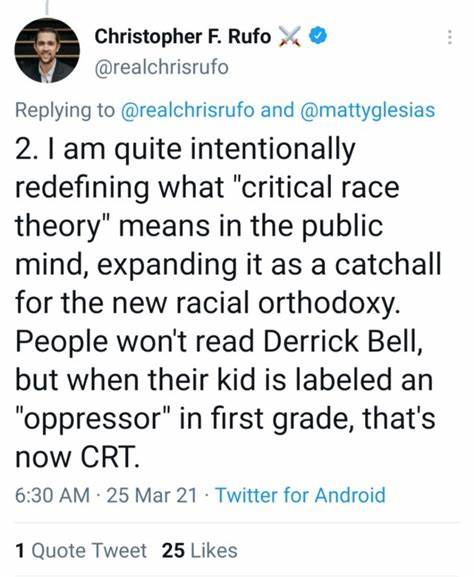
On May 25, 2021, Christopher Rufo tweeted, “I am quite intentionally redefining what ‘critical race theory’ means in the public mind, expanding it as a catchall for the new racial orthodoxy. People won’t read Derrick Bell, but when their kid is labeled an ‘oppressor’ in first grade, that’s now CRT.” Note that he didn’t say that CRT calls for the labeling of first grade kids as oppressors (because it doesn’t); he said that when and if (IF) that happens he’s poisoned the well so much that parents will assume (incorrectly) that’s CRT. A week earlier, he had tweeted, “We have successfully frozen their brand – ‘critical race theory’ – into the public conversation and are steadily driving up negative perceptions. We will eventually turn it toxic, as we put all of the various cultural insanities under their brand category.”

As the saying goes, when they tell you who they are, believe them. Rufo openly boasted about his plan to slander CRT, and we should take him at his word that that’s what he and his fellow anti-CRT voices have done and are doing. Unfortunately, many Christians have swallowed hook, line, and sinker the openly (and proudly) deceitful campaign of the anti-CRT crowd.[5] Books, pamphlets, articles, entire websites, and conferences have been organized around the goal of turning CRT toxic for Christians. While the lies and strawmen pile mountainously high, the deceitful misrepresentation about how CRT defines racism is the single biggest criticism I hear about CRT from friends and what I read on social media.
I use words like “lie” and “deceit” knowing that not everyone is intentionally lying. At the ground level, people are largely just repeating what they’ve read and heard from the anti-CRT crowd. They’re not necessarily lying, but it’s still shameful. As far as the professional anti-CRT crowd goes, they’re either lying about CRT or lying about having read/studied it; I guess the option remains open that they have read it but didn’t understand what they read. Although, I find that option hard to believe when discussing how CRT defines racism. The actual definition can be found in black and white in the books they demonize.
Three things to keep in mind about this article: 1. I use a higher ratio of direct quotes to word count than usual in this article. If you read my articles, you know that I place great importance on citing sources to back up my claims. But I try to do so without piling up so many quotes that the article is minus my thoughts. With this article, I’m going to pile up outside quote after outside quote. I’m doing this because I want to allow CRT to speak for itself. Of course, I’ll add my thoughts, but I use more quotes compared to my words in this article than what might generally be considered appropriate for most articles. 2. I’m not going to defend the reality of systemic racism. If you believe that systemic racism is a myth, my argument in support of systemic racism will need to wait for a future article. My purpose with this article is to demonstrate that CRT uses a definition of racism (and racist) that is different (most likely) than your definition of racism. You do not need to accept the validity of systemic racism to recognize and acknowledge that. My objective is to undermine the anti-CRT deceit that claims that CRT condemns all white people with no hope for redemption. That language is so foreign to CRT that it can actually result in a problem the other way, as I’ll argue later in this article. And 3. I’m using six sources: Critical Race Theory: An Introduction by Richard Delgado and Jean Stefancic; White Fragility by Robin DiAngelo; On Critical Race Theory by Victor Ray; Racism Without Racists by Eduardo Bonilla-Silva; Racecraft: The Sound of Inequality in American Life by Karen Fields and Barbara Fields; and How to Be an Antiracist by Ibram X. Kendi. All six books are accessible and, with the exception of Dr. Ray’s book and the book by the Fields sisters, frequently cited and attacked by the anti-CRT crowd. Out of the six, Racism Without Racists is the one I recommend the highest; it’s also the most academic. Interestingly, How to Be an Antiracist, possibly the most attacked book from my list, actually puts forward different definitions of racism and racist from the other five, as you’ll see, while still serving as a refutation of the attacks on CRT. Ibram X. Kendi and Robin DiAngelo are the two best known out of all the authors (with the possible exception of Richard Delgado) owing to their books having spent time on the New York Times Bestseller List. Both Kendi and DiAngelo have entered the realm of pop culture. As such, they make for handy targets for the anti-CRT crowd. I want all the authors’ words to speak for themselves and demonstrate the falsity being promoted as truth among white evangelicalism.
So, first off: does CRT teach that all white people are racists? Well, that depends on how you define racist. Most likely, your definition of racist differs from CRT’s definition.
In the very first chapter of her much maligned book White Fragility, Robin DiAngelo writes, “So let me be clear: If your definition of a racist is someone who holds conscious dislike of people because of race, then I agree that it is offensive for me to suggest that you are racist when I don’t know you. I also agree that if this is your definition of racism, and you are against racism, then you are not a racist.”[6]
Dr. DiAngelo’s quote probably doesn’t need any further unpacking by me. However, I do want to point out that right off the bat, Dr. DiAngelo graciously acknowledges that you – the reader – may have a different definition of racism than she does. Furthermore, she’s willing and happy to allow your definition to stand when in conversation with you. What she’s asking is for you to simply set aside your definition while reading her book and reciprocate her graciousness by interacting with her argument within the parameters of her definition.
I may need to provide a little commentary for this quote from Eduardo Bonilla-Silva, “I do not subscribe to individual-level analysis of racial affairs. … I plead to you again, as I did in the introduction and in chapter 2, to work hard and do your best not to take this book and my arguments personally [emphasis kept].”[7]
Ask yourself this question, if Dr. Bonilla-Silva doesn’t want white readers to “take [his] book and [his] arguments personally,” and he clearly says he doesn’t, how does his definition match the argument that CRT teaches that all white people are racist with no hope of redemption? Does his definition match the definition that is used to condemn CRT? Well, I don’t know how you answered, and you shouldn’t care what I think, so I’m going to allow Dr. Bonilla-Silva’s words to answer for themselves.
Firstly, he says, “One reason why, in general terms, Whites and people of color cannot agree on racial matters is because they conceive terms such as ‘racism’ very differently. Whereas for most Whites racism is prejudice, for most people of color racism is systemic or institutionalized.”[8] On the same page he provides an academic definition of racism: “my model is not anchored in actor’s affective dispositions (although effective dispositions may be manifest or latent in the way many express their racial views). Instead, it is based on a materialist interpretation of racial matters and thus sees the view of actors as corresponding to their systemic location.”[9] In other words, racism, as defined by Dr. Bonilla-Silva, isn’t about how you feel about different ethnicities; it’s about how you’re situated, through no fault of your own, in a system that benefits some ethnicities while disadvantaging other ethnicities. Victor Ray helpfully explains, “Rather than seeing racism as purely individual, critical race theorists argue that racism is structural.”[10] And this next part is of the upmost importance: Speaking directly to his white readers, Bonilla-Silva insists, “My argument is not about you as an individual, but about you as a mostly unaware embodiment of the racial system [emphasis kept].”[11] A few pages later, he expounds by writing, “My big point is that systemic racism is you! Not you as Kevin, Crystal, Jonathan, or Jessica, but you as a member of the racial group in charge; you as a (mostly) unconscious personification of the American racial order. And it could not be otherwise. If racism is systemic, then we all take part in it.”[12]
Maybe helping to see the difference, specifically where individual responsibility comes in, Dr. Bonilla-Silva explains, “White reader, you are not George Wallace, David Duke, or a member of the Michigan Militia, but you participate in systemic racism in a passive, even neutral way. You follow Whites’ dominant racial script, blame racism on the ‘racists’ and keep collecting ‘the wages of whiteness.’”[13] In fact, “Systemic racism may even be you, proud White liberal, shouting ‘Black Lives Matter’ for two hours in a rally to return afterward to your ‘All White Lives Matter’ reality.”[14]
That’s a lot, I know, but I believe an honest reading of Dr. Bonilla-Silva’s quotes demands the realization that he’s using racism differently than the colloquial definition that dominates most of society. When he says that someone is “racist,” he’s not claiming, at all, that they harbor bigotry and hate towards others in their heart. He’s making the imminent structuralist claim that people unwittingly participate in the system of racism via their place in society. An important point is that this participation doesn’t come weighted with guilt. In fact, guilt is a selfish emotion here. White guilt is unhelpful because it turns systemic societal problems into self-serving problems for white people. Acknowledging and accepting Dr. Bonilla-Silva’s definition (and CRT’s, in general) of racism calls for action, not handwringing, crying, apologies, and feelings of shame. There’s nothing to repent of, hence, no redemption is necessary in this ideological framework.
Robin DiAngelo, on the heels of blowing holes in the anti-CRT’s accusations by writing that if your definition of racism is bigotry “and you are against racism, they you are not a racist” adds, “Now breathe, I am not using this definition of racism, and I am not saying that you are immoral.”[15] She explains, “To understand racism, we need to first distinguish it from mere prejudice and discrimination.”[16] Dr. Bonilla-Silva goes a step further by insisting, “Discrimination, or the intentional racial action of Whites, is not the key for understanding the thickness of race in society.”[17] A few pages earlier, he had explained, “The commonsense view pins racism to bad individuals (‘the racists’), which limits our capacity to understand its collective nature. Racism, in the mind of most people in the world, is a matter of a few rotten apples. In contrast, I have argued that racism is the product of racial domination projects (e.g., colonialism, slavery, labor migration). Once these racial projects emerged in human history, racism became embedded in societies, that is, it became systemic racism [emphasis kept].”[18] The Fields sisters point out, “Racism refers to the theory and the practice of applying a social, civic, or legal double standard based on ancestry, and to the ideology surrounding such a double standard. … Racism is not an emotion or state of mind, such as intolerance, bigotry, hatred, or malevolence.”[19]
The picture should be clear at this point. Even if you disagree with the above scholars’ contention that systemic racism exists, the fact remains that their definition of racism precludes personal guilt and the need for redemption. It’s simply not true – it’s a lie – to claim that CRT condemns white people to guilt in perpetuity with no hope for redemption. In her book White Fragility, Dr. Robin DiAngelo devotes an entire chapter to debunking the “Good/Bad Binary” often put forward in discussions about racism. Her main point in chapter 5 is to reveal how reducing racism to bigotry serves to stall progress when seeking racial justice. For her, and echoing other CRT scholars, existing as a racist (using her definition which doesn’t include bigotry) does not confer ethical pejoratives on individuals nor a moral judgment. Being a racist (using her definition which doesn’t include bigotry) has no bearing on whether or not an individual is bad or good. In fact, as opposed to what the anti-CRT crowd asserts about CRT, being a racist isn’t immutable. She concludes the chapter by writing, “I am not in a fixed position on the continuum [of racism]; my position is dictated by what I am actually doing at a given time. Conceptualizing myself on an active continuum changes the question from whether I am or am not racist to a much more constructive question: Am I actively seeking to disrupt racism in this context?”[20]
So, for Robin DiAngelo, racism isn’t weighted with moral baggage and isn’t immutable, meaning it lacks a soteriological dimension. Being a racist, in her definition (and within the prominent definition across CRT) carries with it zero guilt and isn’t a fixed position anyway. In the final chapter of her book, she has a subsection titled “The Question of Guilt.” In that section, she explains, “I am sometimes asked whether my work reinforces and take advantage of white guilt. But I don’t see my efforts to uncover how race shapes my life as a matter of guilt. … I don’t feel guilty about racism. I didn’t choose this socialization, and it could not be avoided. But I am responsible for my role in it. To the degree that I have done my best in each moment to interrupt my participation, I can rest with a clearer conscience. But that clear conscience is not achieved by complacency or a sense that I have arrived.”[21]
In black-and-white print, the author of White Fragility unequivocally states that she doesn’t feel guilty about racism. If nothing else, that claim by Robin DiAngelo should cause you to be curious to learn more about what CRT means by racism. This short article and its many quotes are only an appetizer. But her statement should also serve as a bulwark against the deceit of Christopher Rufo and the anti-CRT henchmen spreading lies and knocking down strawmen that they’ve deceitfully constructed. There is an important point in DiAngelo’s quote, though: While white people shouldn’t feel guilty about racism, failure to act in ways that promote justice and equity is self-serving. Jesus calls us to love our neighbor, and CRT helps us see how we can better love our BIPOC neighbors.
Now, and here’s my muted criticism: while I am thankful for CRT and how it can help us understand how systemic racism works and enable us to better obey Jesus, I believe that it can let white people off the hook on a personal basis. I am fully aware how counter-intuitive that previous sentence is to most people whose understanding of CRT is largely provided by dishonest sources. I stand by it, though. Doubling down, I believe that CRT’s anthropology can be too optimistic. At times, some proponents of CRT fail to account for how deeply and tragically the Fall and the Curse have ruined relationships. While I agree with CRT that systemic racism is a dominant structure of our society, I also believe that white people should personally mourn and repent (to be clear, some CRT scholars agree even if they wouldn’t use biblical language; I believe Robin DiAngelo’s quote from above helpfully reflects this). However, this is a larger conversation that I’m going to set aside. I bring it up because I find it ironic (and telling) that my criticisms of CRT exist in a place 180 degrees from the anti-CRT crowd. Personal sin/rebellion is real, and two things can be true at once: 1. It’s true that as a white person I benefit through no fault of my own from systemic racism. But 2. It’s also true that my heart is deceitfully wicked (sinful) and my natural fallen/sinful bent is to serve myself at the expense of others. This is why I disagree with Dr. Bonilla-Silva when he writes, “Systemic racism in America is not about bad people, but about many seemingly good people following racialized norms, rules, ideas, and practices and acting racially, often unaware or in automatic fashion.”[22]
I argue that one of the weaknesses of CRT is that the system can become too disconnected from a biblical anthropology and, hence, divorced from a soteriology and eschatology. It can become too imminent. Dr. Bonilla-Silva makes it clear that, “systemic racism should be conceived in materialist rather than idealist fashion.”[23] In his footnote to that quote, Dr. Bonilla-Silva adds, “Idealism, in philosophical terms, means that ideas are the mover and shaker of social action. Materialism (and there are many versions) proposes that real, material processes are the foundation of consciousness and social action.”[24] This is a cognizant extension of Marx and Engel’s claim, “It is not consciousness that determines life, but life that determines consciousness.”[25] For the majority of CRT scholars, not only do they refuse to attribute things like guilt and salvation to systemic racism, but they also appear to refuse to apply morality to the question. White people aren’t racists in their definition – and please keep in mind their definition – because of bad ideas; they’re racist because material structures are determinative, and this includes determinative for ideas, too. Personal responsibility at times is abrogated and, therefore, personal guilt and the need for repentance and salvation can also be abrogated. To be clear, I disagree with that, but it also reflects a complete renunciation of much of what the anti-CRT condemns about CRT.
I want to acknowledge that the previous two paragraphs offer a great offramp to this article’s conclusion, but I have yet to quote the (in)famous Ibram X. Kendi. I’ve done so – waited to quote him – because his definitions of racism and racist differ from what’s found across the bulk of CRT. Not only does this demonstrate that CRT is not as monolithic as its detractors pretend, but Dr. Kendi’s definitions expose even more the outright deceit of the anti-CRT crowd. You see, Dr. Kendi differentiates between racism and racist. In doing so, he blows holes in the anti-CRT crowd’s arguments. How to Be an Antiracist stands in clear contradiction to the lies and strawmen presented by the anti-CRT crowd. Because of that, I believe it’s worthwhile to quote from Dr. Kendi’s book. And I start with this quote, “To be antiracist is to never conflate racist individuals with White people, knowing there are antiracist White individuals and racist individuals of color.”[26]
As one of the main punching bag villains of the anti-CRT crowd, Ibram X. Kendi, dodging the punches, baldly states that black people can be racist, too. An important point is that Dr. Kendi differentiates between racism and racist. Similar to the vast majority of CRT scholars, he defines racism in structuralist terms, arguing that white people are participants, often unwittingly, in systemic racism and that we reap its benefits. But at the top of chapter 1, titled “Definitions,” he offers this definition of racist: “One who is expressing an idea of racial hierarchy, or through actions or inactions is supporting a policy that leads to racial inequality or injustice.”[27] However, he adds, repeatedly throughout his book, the notion that, “The good news is that racist and antiracist are not fixed identities. We can be a racist one minute and an antiracist the next.”[28] He even goes so far as to confess that he, a Black man, “used to be racist most of the time.”[29] That doesn’t jive with the deceit and strawmen of the anti-CRT crowd.
To help make even clearer Dr. Kendi’s distinction between racism and racist, he offers the acknowledgment that, “I’ve … realized that ‘individual racism’ is a contradiction in terms. An individual can challenge racism as an antiracist. An individual can express racist ideas, can support racist policies. An individual can be racist. But an individual cannot engage in racism; racism is structural, institutional, and systemic.”[30] Did you catch that? Did you catch how deeply and completely Dr. Kendi refutes the accusations of the anti-CRT crowd? He teaches that white people are not innately racist. And that Black people can be racist. Earlier in his book he argued, “To be antiracist is to never conflate racist individuals with White people, knowing there are antiracist White individuals and racist individuals of color.”[31] Taking his argument a step further, Dr. Kendi explicitly exposes the deceit of the anti-CRT crowd by writing, “Alabama state legislator Chris Pringle misleadingly said that critical race theory ‘basically teaches that certain children are inherently bad people because of the color of their skin.’ But to be antiracist is to condemn this idea. No racial group is inherently bad or good, racist or antiracist.”[32]
I encourage you to read the books I’ve cited. Doing so will reveal the blatant lies of the anti-CRT crowd. The quotes I’ve included above provide just a small glimpse into how deceitfully the likes of Christopher Rufo portray CRT. God’s people should love truth. The anti-CRT crowd is the antithesis of truth and doing the work of their father the devil, the father of lies.
[1] Victor Ray, On Critical Race Theory: Why It Matters & Why You Should Care (New York: Random House, 2022), 17
[2] Richard Delgado and Jean Stefancic, Critical Race Theory: An Introduction (New York: New York University Press, 2012), 7.
[3] Robin DiAngelo, White Fragility: Why It’s So Hard for White People to Talk about Racism (Boston: Beacon Press, 2018), 22.
[4] I’m running the risk of people reading the opening paragraph, not reading any farther, and then resharing the opening paragraph’s quotes on social media to prove how “evil” CRT is.
[5] This speaks to a larger worldview issue. White evangelicals, especially, have adopted en masse a definition of anthropocentric flourishing provided by the Enlightenment’s Epicurean nominalism. Critical race theory threatens that definition of flourishing. To that, I say, Amen, and praise God! Sadly, instead of allowing CRT to serve as a useful tool in exposing how engorged our society has become from the fruit of the Tree of Knowledge of Good and Evil, they except outright lies, misrepresentations, and the refutations of the thinnest of straw men by the anti-CRT crowd.
[6] DiAngelo, White Fragility, 13.
[7] Eduardo Bonilla-Silva, Racism Without Racists: Color-Blind Racism and the Persistence of Racial Inequality in America (New York: Rowman & Littlefield, 2022), 232.
[8] Bonilla-Silva, Racism Without Racists, 8.
[9] Bonilla-Silva, Racism Without Racists, 8.
[10] Ray, On Critical Race Theory, 18.
[11] Bonilla-Silva, Racism Without Racists, 19.
[12] Bonilla-Silva, Racism Without Racists, 27.
[13] Bonilla-Silva, Racism Without Racists, 32.
[14] Bonilla-Silva, Racism Without Racists, 34.
[15] DiAngelo, White Fragility, 13.
[16] DiAngelo, White Fragility, 19.
[17] Bonilla-Silva, Racism Without Racists, 22.
[18] Bonilla-Silva, Racism Without Racists, 20.
[19] Karen E. Fields and Bargara J. Fields, Racecraft: The Soul of Inequality in American Life (London: Verso, 2014), 17.
[20] DiAngelo, White Fragility, 87.
[21] DiAngelo, White Fragility, 149.
[22] Bonilla-Silva, Racism Without Racists, 32.
[23] Bonilla-Silva, Racism Without Racists, 21.
[24] Bonilla-Silva, Racism Without Racists, 263.
[25] Karl Marx and Friedrich Engels, The German Ideology (Amherst, NY: Prometheus Books), 42.
[26] Ibram X. Kendi, How to Be an Antiracist (New York: One World, 2023), 143.
[27] Kendi, How to Be an Antiracist, 15.
[28] Kendi, How to Be an Antiracist, 11.
[29] Kendi, How to Be an Antiracist, 11.
[30] Kendi, How to Be an Antiracist, 241.
[31] Kendi, How to Be an Antiracist, 143.
[32] Kendi, How to Be an Antiracist, 143.
 Practically Known Theology
Good luck with this. That project of wrecking the language and making it unusable for the purposes of telling the truth is vicious and powerful.
LikeLiked by 2 people