by John Ellis
As a teaser, I ended my previous article with this quote from Antonin Artaud: “And if there is still one hellish, truly accursed thing in our time, it is our artistic dallying with forms, instead of being like victims burnt at the stake, signaling through the flames.”[1]
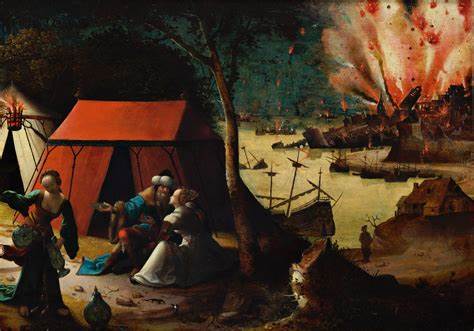
Artaud’s highly imagistic words underline his belief that theatre relies too heavily – almost exclusively, in fact – on words as text. Another way to put it would be that theatre, by and large, views language/dialogue to be in subjection to a controlling truth (or a universal reason) and, ergo, exists on stage to address the mind. Artaud contrasts Western theatre with “The Daughters of Lot” painted by Lucas van den Leyden. He writes of the ideas offered by the painting – the idea of Chaos, idea of Marvelous, idea of Fatality, etc. – and says, “that their poetic grandeur, their concrete efficacity upon us, is a result of their being metaphysical; their spiritual profundity is inseparable from the formal and exterior harmony of the picture.”[2]
Theatre, on the other hand, and unfortunately, most often speaks at the audience across an intentional divide. Western theatre rarely offers real communion with its audience, hence, no real spiritual profundity. Calling for theatre to find, “a language by means of which theater is able to differentiate itself from speech,” Artaud insists that this language, “is addressed first of all to the senses instead of being addressed primarily to the mind as is the language of words.”[3] It’s a language that bridges distances and closes divisions, a language that fosters communion.
To be clear, Artaud wasn’t opposed to the use of words – spoken dialogue – in theatre. He recognized, though, that a theatre that is dependent on words as text is a theatre that is mainly a device in the service of dulling the senses of theatre goers. Typical western expressions of theatre, according to Artaud, serve that aim – dulling our senses – instead of confronting us with our humanity. Relying almost exclusively on words as text creates an aesthetic distance that hinders fully embodied and holistic responses. Artaud understood, though, that being confronted with our humanity by artistic expressions that are “signaling through the flames” stands in rebellion to what is largely the Western objective for theatre: power/control.
Similarly, the Brazilian theatre director, teacher, and theoretician Augusto Boal pinpointed and pushed back on the (largely) Western objective for theatre. With an astute observation, Boal asserts, “The ruling classes strive to take permanent hold of the theater and utilize it as a tool for domination. In so doing, they change the very concept of what ‘theater’ is.” He goes on to explain that for theatre to accomplish its true objective, “change is imperative.”[4]
This isn’t an article about theatre, though; it’s an article about worship services. I’m leaning on theatre theory because (a.) theatre is my background, and (b.) more importantly, the aesthetic principles and theories that dominate “traditional” theatre in the West don’t just provide parallels to worship services, those principles and theories dominate how worship services in the West are shaped and conducted, too. In his book The Empty Space, Peter Brook develops a taxonomy that divides theatre into the Deadly, Holy, Rough, and Immediate. I contend that the same aesthetic theories that produce deadly theatre also produce deadly worship services. Shamefully, it appears that the overwhelming majority of white evangelical worship services are deadly.[5]
In Dialectic of Enlightenment, Max Horkheimer and Theodor Adorno argue that the modern West’s project of power[6] – of domination and imperialism – has its genesis in ancient Greece. It wasn’t that the West woke up in the middle of the second millennium A.D. and discovered power/control; that program had already been baked in by the progenitors of the West, even going back as far as the pre-Socratics.
The great debate/question held by the pre-Socratics was the question of the one and the many. How could the one and the many coexist? Can they coexist? At its heart, the question is “what is the nature of reality?” Or “what is nature?” It’s a question of ontology. And beginning with Thales, the early Greek philosophers embarked on a program of power/control/mastery. Rebelling against the chaotic and capricious forces of the gods within their society’s mythologies, the pre-Socratics were the so-called first men of science in the West.[7] Edward Hussey points to Xenophanes as a clear example of what this looked like. “Xenophanes makes no appeal to the authority of a prophet or teacher, still less to any personal revelation. He relies entirely on certain general principles. … This way of thinking … was something quite new. For the first time, a conscious and deliberate attempt had been made to set up a standard of what was and was not ‘reasonable’ or ‘fitting’ … Everything was to be judged in terms of this standard alone, and the authority of tradition, or of a general consensus, or of a great teacher, was to count for nothing.”[8]
There is a through-line-of-action running directly from “[Xenophanes’] way of thinking” to Francis Bacon and the epistemologies of the Scientific Revolution, the subsequent period known as the Enlightenment, and the epistemologies of modernity that dominate our collective Western perspective on reality/being. Even stretching back 2,500 years, the division of the subject and the object was already apparent. The nominalism of Francis Bacon’s “Therefore, no doubt, the sovereignty of man lieth hid in knowledge”[9] wasn’t birthed in an epistemological (and anthropological) vacuum. Importantly for this article, this means that the ontological soil from which Aristotle’s Poetics grew isn’t foreign to us even if we’re unable to articulate that ontological soil. However, articulating that ontological soil is a necessary component for seeing what Aristotle was after and, hence, how Western modernity’s aesthetic theories help create deadly worship.
Boal makes the cogent argument that comprehending Aristotle’s poetics requires understanding what he meant by nature/life in his famous argument that art imitates (mimesis – recreates) nature/life.[10] For Aristotle, nature/life is one of order and progression; everything moves towards its telos, towards perfection even if it doesn’t always attain it. At least, according to Aristotle, it should and, importantly, can move towards and even possibly attain this perfection.[11] Art, by recreating either the negative or positive trajectory of the teleological journey, serves this program by encouraging personal mastery – nominalist mastery – over life/reality (movement/growth) through the purification process of catharsis. Ironically, in this concept, we exercise control by submitting to the status quo (this is the “emperor’s new clothes” aspect of expressive individualism). You see, nominalism isn’t actually possible; it’s a deceitful tool of imperialism – we can’t all have power, and we can’t all be in control even though we’re told we do and are.[12]
Aristotle’s use of the concept of catharsis is generally misunderstood.[13] For the ancient Greek philosopher, the purification of the audience member serves the status quo by encouraging conformity to the expectations of the polis. And the polis exists to perfect nature, including the citizenry, by helping it achieve its telos. The desired catharsis deliberately undermines true change by setting the subject – the audience member – in isolation from the object – the performance/performers – via aesthetic distance. The relationship of subject and object, then, is one of distance. This, in turn, dulls the senses by the denial of true humanity, causing the audience member to accept the mimesis – the imitation of life/reality and the goals of the polis – as true and good. In a word: control.[14]
It’s important to understand that Aristotle believed that theatre’s telos is to make better citizens – to perfect the polis. As Augusto Boal puts it, “[for Aristotle] that is the purpose of art and science: to correct the faults of nature, by using the suggestions of nature itself.”[15] Aristotle believed that nature was able to be mastered. He believed that a definite order in nature exists; a type of code that humans can unlock, and theatre, through mimesis, can demonstrate this. But was he right? Or, rather, does Aristotle represent the ongoing ontological and epistemological/anthropological rebellion of the West as I believe?
In a magazine article published in 1884, Robert Louis Stevenson famously attacked the novelist Henry James’ fawning appropriation of Aristotle’s objective/telos for art. Writing in Longman’s Magazine, the author of Treasure Island pointed out, contrary to James and Aristotle, that, “Life is monstrous, infinite, illogical, abrupt and poignant; a work of art in comparison is neat, finite, self-contained, rational, flowing, and emasculate. Life imposes by brute energy, like inarticulate thunder; art catches the ear, among the far louder noises of experience, like an air artificially made by a discreet musician.”[16]
Stevenson’s harsh assessment runs parallel (to a point) with an important plot point in the Story of the Bible. Found in Genesis 3, the Curse is all-encompassing. Not one square inch in the domain of our human existence remains untouched by sin, death, and the Curse. Seeking mastery – dominion, control, imperialism, etc. – apart from submission to our Creator is the original sin and is the rebellion that sits at the core of all other sins. Stevenson understood, contra Aristotle (and contra Henry James, among many others), at least as expressed in his magazine article quoted above, that nature is exemplified by brokenness and not by order. Importantly, he also pointed out that Western art overwhelmingly tends to provide through the pretense of mimesis a false recreation of the condition of reality; it tends to “recreate” a false nature that is characterized by an order that doesn’t exist.[17] In doing so, Western art presents a false catharsis. Furthermore, it props up the idolatrous belief that control is not only possible but desirable. And these aren’t the only problems.
Daphne Ben Chaim opens her book Distance in the Theatre: The Aesthetics of Audience Response by instructing the reader how aesthetic distance in modern theatre “evolved from the concept of ‘aesthetic disinterestedness’ present in Aristotle.”[18] Dr. Chaim had already explained that, “Concern with the state of mind, or mode or perception, of the spectator is perhaps the single unvarying feature in the history of [aesthetic distance].”[19] As I’ve pointed out in a previous article, the utilization of aesthetic distance in (most) Western theatre expressions[20] is not up for debate; it’s a fact. The question that’s debated is whether aesthetic distance is helpful/useful or not. What’s more, the implementation of aesthetic distance in most Western churches’ corporate worship is also not up for debate.[21] From the use of lighting, staging, and materially passive role of the “audience” during a large portion of the “theatrical” worship event, to highlight the three most obvious elements, worship services, by and large, heavily employ theories of aesthetic distance, whether that fact is realized or not. Like theatre, the presence of aesthetic distance in most worship services is not up for debate. And like theatre, the question is (should be): is the incorporation of aesthetic distance in worship appropriate or not? Repeating the final sentence of this article’s fourth paragraph: I contend that the same aesthetic theories that produce deadly theatre also produce deadly worship services.
Look, and this is an important (and long) caveat that I originally placed in a footnote, I’m not saying that order isn’t apparent in nature, that order doesn’t exist. This is a tension white evangelicalism contends with poorly most often. The fundamentalism of my youth over-emphasized the brokenness of the world. Much of broader evangelicalism, even – if not especially – the neo-Calvinists, over-emphasize order (and goodness) in nature. I have (had, really, but no longer) plans to write a comprehensive article on this, but this will have to suffice for now: an over-realized and imperialistic (racist) doctrine of common grace dominates much of Western evangelicalism. Shamefully, Abraham Kuyper’s doctrine of common grace can be viewed largely as a program to justify and sanctify (redeem) Western imperialism. Pay attention to the extended quote below from the penultimate chapter of the first volume in his three-volume set Common Grace: God’s Gift for a Fallen World:
“[T]hanks to the continuing development of common grace in human life, the form of the earth has been gradually enriched. If we compare the heart of Africa with [the Western] landscape, we notice the difference. How many deserts have been transformed into beautifully constructed places! How many rivers have been dammed in their flow! How many wetlands have been pumped dry and turned into fields! How many regions that once were wild have been tamed and turned into delightful residential areas! What treasures have been brought up from the depths of the earth; what natural forces that lay dormant have been awakened; in how many ways has the human hand brought the form and value of the ground to a higher level! So we see how common grace includes far more than simply bringing about civic righteousness, but one its fruits was to transform the earth that once produced thorns and thistles into a beautiful, luxuriant, profitable, nature. This the world has continued to exist, its collapse has been arrested, and when Jesus returns, common grace will equip the earth completely in order as such to be renewed by Christ and disclosed in its most luxuriant development.”[22]
Using the Noahic covenant as his jumping off point for common grace, and in what can only be described as a version of the prosperity gospel, the Fall and Curse affects cultures differently based on their obedience to God, according to Kuyper. This is why he repeatedly contrasts the West with Africa (and Asia). Earlier in volume 1 of Common Grace he makes the explicitly racist claim that, “This Noahic covenant applies to all peoples, and if only the native tribes in the heart of Africa and the Mongolian people of Asia realized this, they would be able to savor the joy of knowing that the almighty God, Lord of heaven of earth, has entered into a permanent covenant with them also.” And lest you make the mistake of thinking that Kuyper is speaking soteriological, take note that he believes, “Consequently, this covenant is similar to the promise of an inheritance made to all the children of the same family, but which can be enjoyed and appreciated only by those children who have reached the age of discretion.”[23] This reeks of many things, but one unmistakable odor is that of Comte’s logical positivism that was used as the basis for the Spencerian/evolutionary anthropology developed in the 19th century to explain the others – those who had been colonized.[24] Comte’s historical ages fit snugly over Kuyper’s “age of discretion.” In other words, Kuyper believed that the peoples of Africa and Asia needed to progress to the same stage as the West. But instead of the material forces of history found in Comte, Kuyper leaned on common grace and obedience to God to explain the differences between cultures. I mean, my word, during the Stone Lectures, he praised the Boers of South Africa – you know, the white people who created apartheid in South Africa – for spreading God’s blessings “in the South of the Dark Continent.”[25]
For Kuyper, and many (most) white evangelicals, even those who’ve never heard of the Dutch theologian/politician, the West’s prosperity is evidence of God’s blessings. The inverse of this can be heard in contemporary cultural wars. It’s argued that the specific wickedness of progressives is undermining our national prosperity and that a return to obedience to God is necessary for the United States’ glory to return.[26] That implies that the wealth and domination of the United States is the result of obedience to God and not the result of the stealing of land and labor that created the American empire.
Tying this into my thesis and main argument, Abraham Kuyper “redeemed” imperialism/colonialism with his doctrine of common grace. He justified the West’s raping and pillaging of the Americas, Africa, and Asia because we – white Westerners – are (have been) in obedience and submission to God. The world has been gifted with Western culture (classical liberalism, American Dream, etc.) because of this obedience and submission. Explicitly declaring that the United States and England are Christian nations, explaining their material blessings/cultural superiority, Kuyper makes the ahistorical claim that, “In both countries government still stands on the foundation of God’s Word.”[27] Furthermore, according to Kuyper, colonialism extends God’s blessings via common grace to the unenlightened “savages” in the world’s “dark” places.
A clear reading of Kuyper reveals that he conflates common grace with the western worldview, to the point of the two being almost synonymous. While most of white evangelicalism doesn’t fall under the tag of neo-Calvinism, Kuyper’s conflation of common grace with the western/Christendom worldview is part of the warp and woof of white evangelicalism. I doubt that I need to make the argument that a dangerous God and country ideology is dominant within white evangelicalism. In this extended caveat/excursus, my objective has been to demonstrate that neo-Calvinists are as bogged down by this ungodly syncretism as the explicit God and country crowd dominating mainstream white evangelicalism. And Robert Louis Stevenson’s takedown of Henry James is applicable here. Western culture is broken; it’s not evidence of God’s blessings. Using Stevenson’s description, it’s monstrous. It’s a Tower of Babel that centers a nominalist autonomy that prioritizes power/control. Yet we – white evangelicals, including neo-Calvinists – celebrate and defend it, and our corporate worship serves the telos of nominalist autonomy. This helps explain why we cling so stubbornly, even if blindly, to theories of aesthetic distance in corporate worship. Like the Greek plays Aristotle preferred,[28] white evangelical worship services serve the status quo of the preferred polis/culture.
The status quo of all Westerners, including those who profess to be Christian, is one of living in a society shaped and guided by Western imperialism. Via the aesthetic forms employed in worship services (as well as through explicit lip service at times), our churches help “sanctify” – or “redeem” – the Western/Christendom worldview. Aesthetic distance serves the imperialistic program by creating stasis via catharsis in the audience member/church goer. The false order/goodness portrayed within our particular Babylon is left unchallenged, at times deliberately praised and encouraged, meaning that God’s people fail to be the prophetic voice to a broken and fallen culture that we’re called to be.
On top of how theories of aesthetic distance exist, by and large, for and in the service of Western lust for power and control/imperialism, aesthetic distance is an ontological denial of who (what) we are. We are created for relationships. Our being is one of relationship.
An important – if not the important – element of the Curse is separation – distance. Prior to the Curse, image bearers existed in a state of right/good relationship with their Creator, with each other, and with nature. Since the initial rebellion of our first father and mother, image bearers have existed in a reality dominated by division – by distance. The Curse communicates this directly. Our relationship with God, with others, and with nature is no longer primarily characterized by the good of Genesis 2. Tensions exist, to the point of near-constant ruptures. But the distance between us and God, us and each other, and us and nature do not reflect who and what God intended for his image bearers to be and how to exist. Distance, specifically the kind sought after and produced by theories of aesthetic distance in theatre and incorporated in many worship services, feeds the effects of the Curse while denying God’s intention for us.
The Story of the Bible – the gospel of Jesus Christ – is the story of how God heals the world and closes the distance, restoring His creation to right relationships. The Incarnation is a story of the removal of distance. Jesus bridged the gap between humanity and the Trinity. He stepped off the heavenly stage and into the earthly audience, shoving aside the forms of aesthetic distance. It is instructive, though, that Jesus incorporated the use of aesthetic distance at certain times for a very specific purpose. The restoration of all relationships is not a fait accompli, no matter how much our universalist friends believe that to be true. And so, Jesus spoke in parables at times so that those who are not his would not respond. During those moments, Jesus kept the distance intact. I mention this because it highlights how aesthetic distance has very little, if any, usefulness in the worship services of God’s people. The divisions it creates work at cross-purposes with the objectives of corporate worship. In contrast to his use of aesthetic distance in parables, Jesus continuously bridged the divisions and distance between himself and his disciples. Even as he stared down his own death, during his high priestly prayer, he asked the Father, “I pray also for those who will believe in me through their message, that all of them may be one, Father, just as you are in me and I am in you. May they also be in us so that the world may believe that you have sent me (John 17:20-21).”
Much is made in evangelical churches about unity, and rightfully so: the unity found in Christ and the unity of the gospel. Unfortunately, reflecting the mind-centered, control-desiring epistemologies we’ve inherited and embraced, the unity found in Christ is most often reduced to agreement on the essentials allowing for charitable disagreement on tertiary issues. But the unity Jesus prayed for, and the unity his Spirit provides, is much richer than that. It’s a mystical relationship that defies the nominalism of our secular age. It’s a unity that highlights the brokenness and distance in other relationships. This is one of the reasons why the world hates those who follow Jesus; we’re an uncomfortable reminder that their beloved rebellion negatively affects their very ontology. True union doesn’t allow for hierarchies; it doesn’t allow for power and control. How can I be like God if I’m at one with my brothers and sisters in Christ? The answer is, I can’t. That truth exposes our heart’s coup on God’s throne. The utilization of aesthetic distance in corporate worship helps allow that coup to go unchallenged.
It’s not a coincidence that the forms of the Bible’s theatre expressions (of which there are more than most people realize) stand in direct contradiction to the forms of Greek theatre from which Western theatre has descended. The Bible presents theatre expressions that are fully embodied and integrated forms that dogmatically eschew theories of aesthetic distance (you can read more about that by clicking here). Likewise, our churches should also seek to eschew the employment of aesthetic distance in corporate worship.
What this looks like is scary. I realize this. It requires an almost total reorientation of how we think corporate worship should be and the subsequent retooling of our corporate worship. Frankly, I don’t believe it’s possible in mega-churches, at all. In fact, I’m not sure that it’s even possible in medium-size churches. During the last few years of my theatre career, I began working out theatre expressions that reject aesthetic distance and the hierarchies of power that comes with it.[29] I believe that I’m beginning to see expressions of corporate worship that also reject aesthetic distance. In the (hopefully) near future, I’ll be working out some of this on “paper.” I think, ripping the most-secured Band-Aid off to start with, I’ll begin with the problems of the pulpit and the preacher. Church communities in this country are anemic, at best. We’ve willfully embraced the West’s program of power and control, and this is evidenced by the utilization of theories of aesthetic distance in our corporate worship. This must change.
To truly be a light to the world, to be faithful witnesses to the Resurrection, our gathered worship should foster a union that is as real as it is mystical. Aesthetic distance exists for the exact opposite purpose as that. When aesthetic distance is employed in worship services it furthers the effects of the Curse while denying that the Second Adam is undoing the Curse and making all things right. The world needs us – the Church – to signal through the flames. Through that comes the call to the true change of dying to self, picking up your cross, and following Jesus.
Addendum: If you’re reading this, I’m guessing you read the entire article. Thank you. This article is long and probably not an easy read. To be blunt, and while I truly hope that you (and others) found this article engaging and thought provoking, I wrote this (rewrote since the original was published on my defunct Substack) mostly for myself; to help me articulate my own thoughts. If I were in the book writing business, I’d develop the undercooked ideas and assertions in this article into a long book. For those interested, I am working on another article – a much shorter and more accessible article – that takes my criticisms of corporate worship in a more positive direction. I don’t write as often as I used to, but I’m hoping to have that article up within the month.
[1] Antonin Artaud, The Theater and Its Double (New York: Grove Press, 1958), 13.
[2] Artaud, The Theater and Its Double, 36.
[3] Artaud, The Theater and Its Double, 38.
[4] Augusto Boal, Theatre of the Oppressed (New York: Theatre Communications Group, 1985), ix.
[5] This is not a scientific claim, and least not definitionally, I realize. I do not have the data to back this claim. However, my experience strongly suggests to the point of almost certainty, that my claim is true. Doubt me? Then provide an example of a white evangelical worship service that doesn’t operate largely according to theories of aesthetic distance.
[6] “The ‘happy match’ between human understanding and the nature of things that [Bacon] envisaged is a patriarchal one: the mind, conquering superstition, is to rule over disenchanted nature. Knowledge, which is power, knows no limits, either in its enslavement of creation or in its deference to worldly masters. … What human beings [in the post-Enlightenment West] seek to learn from nature is how to use it to dominate wholly both it and human beings.” Adorna and Horkheimer, Dialectic of Enlightenment (Stanford, CA: Stanford University Press, 2002), 2.
[7] Contra the cultural apologists, it should be pointed out that this bent towards a nominalist rejection of myths isn’t necessary for science to flourish. The pantheistic mythologies/religions and animism in the ancient cultures of Mesoamerica, Asia, and Africa didn’t prevent them from running scientific, mathematical, and cultural laps around their Western counterparts.
[8] Edward Hussey, The Pre-Socratics (New York: Charles Scribner’s Sons, 1972), 14.
[9] Francis Bacon, “In Praise of Knowledge” Francis Bacon ed. Athur Johnston (New York: Schocken Books, 1965), 15.
[10] Aristotle, “Poetics” The Basic Works of Aristotle ed. Richard McKeon trans. Ingram Bywater (New York: Random House, 1941), 1453-1487.
[11] The western/Christendom worldview’s belief that the arc of history bends toward justice reflects this Aristotelian belief.
[12] Altering the old adage: if you can’t tell who the subjugated in the room is, well, then you’re the …..
[13] In my formal education, it wasn’t so much that it was taught incorrectly to me; incompletely, is probably more accurate. I was taught what Aristotle expected from theatre (the unities, catharsis, etc.), but I was never taught Aristotle’s why. I was never taught what he believed theatre’s telos is, ironically.
[14] An ironic contradiction exists throughout Western history: control for me but not for thee. The constant spasms of pain in democracies are products of the impossibility of pluralism and expressive individualism.
[15] Boal, Theatre of the Oppressed, 9.
[16] Robert Louis Stevenson, “A Humble Remonstrance” Longman’s Magazine, 5 (November 1884) 139-147.
[17] Thomas Kinkade may be the easiest and most egregious example of this one can point to.
[18] Daphen Ben Chaim, Distance in the Theatre: The Aesthetics of Audience Response (Ann Arbor, MI: UMI Research Press, 1984), 1.
[19] Chaim, Distance in the Theatre, 1.
[20] I suspect that for the majority of those reading this article, when they think of theatre, they are thinking of a theatrical expression that embraces aesthetic distance as a vital component of the art form’s relationship with the audience.
[21] It shouldn’t be up for debate, but it is likely that I am the only person to ever see the parallels. As I told my wife, the people who understand aesthetic distance are, by and large, except for possibly me, people who don’t give two craps about church worship services. In other words, my intended audience – pastors and worship leaders – will find my arguments so new and strange as to dismiss me as a type of Don Quixote, at best, and a raving malcontent who needs to get his heart right, at worst.
[22] Abraham Kuyper, Common Grace: God’s Gift for a Fallen World, Vol. 1 trans. Nelson D. Kloosterman and Ed M. van der Mass (Bellingham, WA: Lexham Press, 2016), 584-585.
[23] Kuyper, Common Grace, 30.
[24] In her book Japan and National Anthropology, Sonia Ryang notes that philosophy was developed to help answer the question why we are the way we are while anthropology was developed to answer the question why they are the way they are. Anthropology was developed alongside and in service to colonization.
[25] Abraham Kuyper, Lectures on Calvinism: Six Lectures from the Stone Foundation Lectures Delivered at Princeton University (Columbia, SC: Read a Classic, 2010), 27.
[26] This argument is less explicit in the neo-Calvinists at TGC, for example, but it’s still there.
[27] Abraham Kuyper, Our Program: A Christian Political Manifesto trans and ed. Harry Van Dyke (Bellingham, WA: Lexham Press, 2015), 13.
[28] The most famous Greek play, Oedipus Rex by Sophocles, made famous because of Aristotle, actually came in last place in the competition at that year’s festival. It’s the play that best conforms to Aristotle’s telos for art/theatre so it’s the Greek play that gets foisted on students the most by a long shot now.
[29] I didn’t do this by myself to be clear. Besides the help of a few others, I had the theories of theatre artists like Artaud, Boal, and others at my disposal.
 Practically Known Theology