by John Ellis
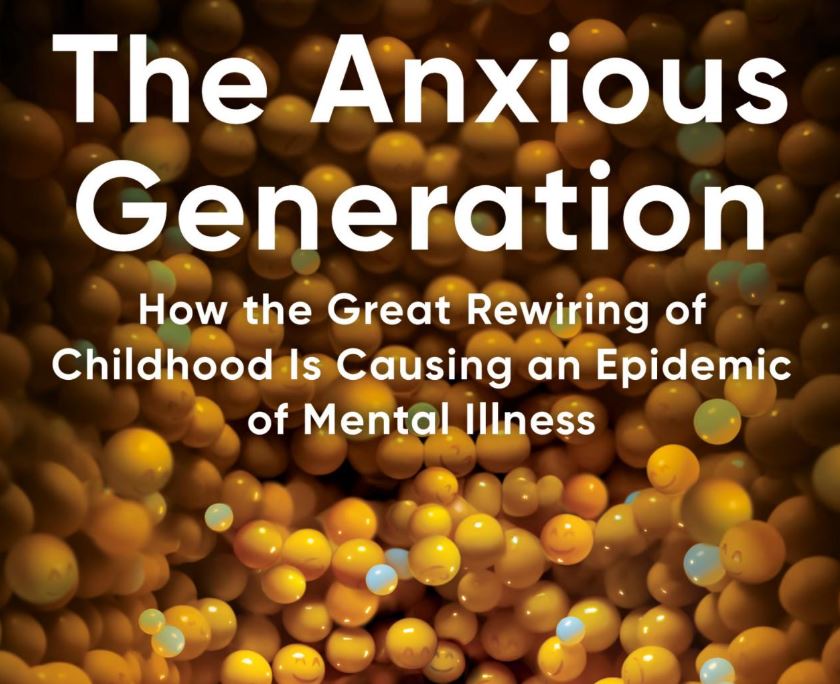
I didn’t read many pages into The Anxious Generation: How the Great Rewiring of Childhood Is Causing an Epidemic of Mental Illness by Jonathan Haidt before methodological red flags began waving in my face. A quick Google search uncovered scores of articles taking The New York Time’s bestseller to task for a litany of problems and issues.[1] So, while continuing my reading of The Anxious Generation, I also indulged in companion readings by data scientists, sociologists, child psychologists, neurologists, etc. who confirmed my suspicion: Haidt overstates some very real concerns and problems, engages in a reductionism shorn of nuance, and lands on one-size-fits-all solutions. To top it off, little of what he claims and argues is supported by the research and data.
Even before finishing The Anxious Generation, I knew I wanted to write a review. It’s a book that has earned the already successful, popular Haidt even more success and popularity. His reach has been magnified by the numerous high-profile TV and podcast appearances as well as the gallons of ink spilled in service of promoting the book. It’s a book that has grabbed the public imagination while seemingly giving anxious parents, educators, and civic leaders a pathway out of our assumed contemporary malaise. In my circle, reformed white evangelicalism,[2] Haidt’s perceived wisdom has taken on a life that transcends the social sciences and generational wars. Reformed white evangelicals have embraced The Anxious Generation as an intellectual cornerstone in their diagnosis of the disenchanted malaise of modernity produced by our so-called secular age. Furthermore, it provides a ready-made prescription that comports well with their love of media ecology in ways that further their Christian fundamentalist luddism without falling prey to Ockenga’s accusation of anti-intellectualism … and that’s a lot of accusations, and part of the reason why I never wrote that review.
Every time I sat down to write the review, it felt like a bigger bite than I was willing or, possibly, capable of chewing. Firstly, writing a deconstruction of the entrenched self-promoting mythologies of white evangelicalism is an epistemological game of pick-up-sticks that causes my head to hurt just thinking about. Secondly, combing through and collating the necessary research/data errors Haidt makes is a time-commitment that doesn’t seem to fall firmly enough in the “benefit” column of a cost/benefit analysis for me at the present time. In short, by necessity, an adequately written review of The Anxious Generation targeting reformed white evangelicals would be so long and dense as to render it practically unreadable for most of its intended audience.[3] More importantly, I ain’t got time for that.
Thankfully, for me, at least, I’ve hit on a solution.
Last week, while in conversation, a friend brought up Jonathan Haidt and The Anxious Generation. This friend, whose expertise fits snugly within a Venn Diagram of those whose expertise relates to Haidt’s thesis, asked, somewhat tentatively, “What do you think of The Anxious Generation?”
Before the last syllables of the word generation had left her mouth, I blurted out the hyperbole, “I hate that f*****g book!”
As the conversation continued, I added that while I find the book very problematic, I don’t actually hate it; it’s the uncritical acceptance of it by people I know (and don’t know) that strikes an emotional chord with me. I also confessed that I long to write a review of it but am too lazy to undertake the necessary work to do so. She asked me if I’d listened to the If Books Could Kill podcast episode about it. I had not.
Apart from the Conan O’Brien Needs a Friend podcast, I rarely listen to podcasts. Coming in a very distant second place of podcasts I’ve listened to, though, is If Books Could Kill, but I haven’t listened to any episodes of it in about two years. I’ve greatly enjoyed the few episodes I’ve listened to,[4] so, to get to my point, I forced my family to listen to The Anxious Generation episode in the car on the way home from South Carolina yesterday. My wife enjoyed it and found it helpful and our 15-yo son loved it. Our eldest was asleep and I’m not sure our nearly 3-yo daughter paid any attention to it. I, too, loved it, bringing me to my main point: I want you to listen to it.
By “you” I mean anyone reading this who has read The Anxious Generation, has previously heard about The Anxious Generation, or has been introduced to Jonathan Haidt’s book for the first time by this article. If you fall into the last camp, you have undoubtedly already been exposed to, if not accept, Haidt’s arguments and solutions. But, please, regardless of which category you’re in, listen to the podcast. It’s long (at least, I think it’s long) but is enjoyable and quite funny at points. To help facilitate the homework I’ve assigned, I’ve linked to the podcast episode below. One sidenote to any conservative folks reading this: do not allow the hosts’ pro-LGBTQ+ stance to cause you to dismiss the episode. Doing so would be intellectually lazy because the two things – their pro-LGBTQ+ stance and their arguments about the book – are not dependent on each other.
One final thing before I wrap this up. When I first conceived of this article yesterday, I intended to provide links to various articles critical of The Anxious Generation that I find helpful. I’ve decided against doing so because it now seems like a little bit of overkill. If you’re interested, reach out to me (my email is included in the About tab of this blog) and ask. I’ll be happy to send you a few links. Also, and even more helpful, the link to the podcast episode includes a list of links to their research – please, pretty please click on some of them and read the research. And so, without further ado, here’s the link to the If Books Could Kill episode about Jonathan Haidt’s The Anxious Generation.
[1] It’s a helpful epistemological rule of thumb, I think, to approach any book dealing with academic topics that hit the NYT best-seller list with extra layers of a hermeneutic of suspicion until proven otherwise.
[2] I no longer consider myself reformed or an evangelical, but almost every person I know – not strangers – and interact with are reformed white evangelicals, so I guess it’s still my circle.
[3] You can describe that as insulting if you’d like. It probably is. But that doesn’t mean it’s not true.
[4] The first episode I listened to was the one on that idiotic book Men Are From Mars; Women Are From Venus by John Gray. My wife listened to the episode with me and loved it, too.
 Practically Known Theology