by John Ellis
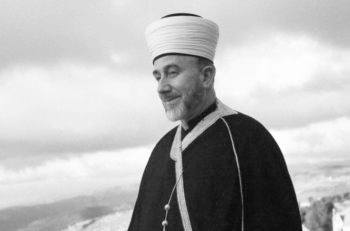
Even though its publication was suppressed through the efforts of Zionist supporters in the British government, the Palin Commission still produced drastic changes. Prime Minister Lloyd George recalled the military administration in Palestine, installed a civilian administration instead, and appointed Herbert Samuel as the High Commissioner. “Samuel, a Jew and a leading Liberal, had been the first member of the British government … to have proposed the creation of a British-sponsored Jewish homeland in Palestine.”[1] Lloyd George was signaling that his government was committed to seeing the Balfour Declaration’s aim come to fruition. Surprisingly, and somewhat ironically, one of Samuel’s first acts as High Commissioner was to pardon Al-Haji Amin al-Husayni (referred to as Amin or the Mufti for the remainder of this article).
Samuel’s specific reasoning for the pardon is lost to history. Clues do exist, though, in his writings, both official and unofficial. Palestinian historians often argue that “Samuel wanted to balance the power of the Nashashibis, who now controlled the mayoralty of Jerusalem, with that of the Husaynis, so as to rule more effectively over a divided people.”[2] Offering a counter explanation, the Zionist historian Joseph Schechtman wrote that Samuel was “haunted by the fear of appearing too pro-Jewish.”[3] The obvious implication can be found in the analogous and somewhat crass example of when a basketball referee calls a foul on one end of the court to balance out a call he made on the other end of the court. According to Schechtman, who accused Samuel of having an “impartiality complex,” the High Commissioner made the mistake of pardoning Amin because he was afraid of being accused of putting his hand on the balance of power in ways that privileged the Zionists.
While persuasive arguments do exist on both sides, I find Philip Mattar’s explanation the most convincing. The Mufti’s biographer argues, “The key to understanding Samuel’s pardon and, for that matter, his other actions toward Amin and the Palestinians, has little to do with notions of a Jewish complex or dividing the Palestinians. Rather, it has to do with Samuel’s view of his role as High Commissioner and the policy he should follow.”[4] In Herbert Samuel’s own words, included in his first official report as High Commissioner, “I was there to administer the country, not for the benefit of one section of the population only, but for all; not commissioned by the Zionists but in the name of the King.”[5] England’s official pronouncement on the Zionist/Palestine question, the Balfour Declaration, clearly calls for the protection of the rights, both civil and religious, of the current inhabitants of the land – the Palestinians. Samuel was concerned with doing his job faithfully by serving his king and not outside influences, no matter how much he may have agreed with their position; his loyalty was to the King, not to them. In the same report, Samuel denounced Zionists who wanted to “ride rough-shod” over the nearly 700,000 Palestinians already living and working in the land. A committed Zionist himself, Samuel realized, as the Palin Commission had pointed out, that the current inhabitants of the land would not take kindly to their forced removal from their land and/or the destruction of their culture. Understanding that the success of the Zionist movement was partially dependent on the graces of the Palestinians, he “announced a general pardon of political prisoners a week after he took office.”[6] Whether one believes he was correct or not, the new High Commissioner concluded that the best way to fulfill his duties was to pardon Amin. And so, Amin returned to Jerusalem as his brother, the current Grand Mufti, lay dying. On his deathbed, the Grand Mufti Kamil al-Husayni appointed Amin as his successor. Multiple parties opposed that appointment, though. For the British, Kamil’s successor was seen as an important key to stability and peace in the region. Stepping in to help adjudicate the process, the High Commissioner appointed select Muslim leaders to vote on the new Mufti on April 12, 1921. After some political intrigue by the various Muslim factions that threatened to derail the process in ways that would’ve further destabilized the region, Samuel stepped in and put his hand on the scale. He did so against the advice of his counselors, but only after receiving reassurances from Amin about his desire to cooperate with the British. The Zionist Herbert Samuel helped ensure that Amin was elected Mufti of Jerusalem. A decision that would ultimately prove detrimental for both the Palestinian cause and the success of the British Mandate.[7] But between 1922 and 1929, the new Mufti kept his word to Samuel, and a time of general peace and stability covered Palestine.
1922 was still months away, though, and that stability and peace faced another major obstacle that threatened to explode the region into widescale violence. Amin’s calming response to the violence that occurred in May 1921 persuaded Samuel that allowing Amin’s appointment as Mufti was wise. But first, we need to back up a bit in order to take a running start into the May Day Riots of 1921.
Returning to the changes in the Mandate made by Lloyd George after the Nabi Musa riot of 1920, it should be noted that not all the Zionist supporters in his government were as resolute in their commitment as the Prime Minister. His Secretary of State for the Colonies, Winston Churchill, wrote to Lloyd George on June 13, 1920, that “Palestine is costing us 6 millions [sic] a year to hold. The Zionist movement will cause continued friction with the Arabs. The French are opposed to the Zionist movement & will try to cushion the Arabs off on us as the real enemy.”[8]
Churchill’s warning was bolstered by violent revolts in Iraq throughout 1920. David Fromkin points out that the disturbances in Palestine and Iraq “coming after the riots in Egypt, the war in Afghanistan, the religious war in Arabia, the nationalist rebellion in Turkey, and the troubles with French Syria – suggested to many Englishmen that Britian should withdraw from the Middle East entirely.”[9] Churchill eloquently summed up England’s problem by writing, “Thus the whole Middle East presented a most melancholy and alarming picture.”[10]
With the tensions and violence growing in the Middle East, Churchill called for a conference to be held in Cairo in March 1921 to solve England’s problems in the Middle East. This was the conference that saw England pronounce Feisal Hussein as King of Iraq, as referenced in chapter 4, part 1 of this series. Feisal’s brother Abdullah was crowned king of Transjordan (now simply known as Jordan). Andrew Roberts points to Churchill’s overly optimistic idealism at the conference as embodied by his “idea for a pan-Arab confederation … in which there would be room for a Jewish homeland.”[11] Demonstrating the same naïve ignorance displayed by the Big Three during the Paris Peace Conference, Churchill revealed his lack of knowledge about the Middle East and Islam during the Cairo Conference of 1921. But colonizers tend to have self-involved blinders on that outside parties are usually unwilling to take off, being afraid to risk the ire of those in power. Even apart from the Jewish question, Churchill failed to grasp the religious (and civic) differences between Ibn Saud, the founder and first King of Saudi Arabia, and the Hussein family (the Grand Shariff and his sons – two of whom England had crowned as kings in Iraq and Transjordan). Differences that made alliances between the two ruling families practically unworkable. Another notable objective that Churchill succeeded in implementing at the conference was the prohibition of Jewish immigration east of the Jordan River. This angered the Zionists, although Churchill was unaware of that; he believed he’d found an acceptable compromise.
Upon the Cairo Conference’s conclusion, Churchill made his way to Palestine. While there, he met with the Executive Committee of the Haifa Congress of Palestinian Arabs who urged him to renounce the Balfour Declaration. Demonstrating his belief that the Cairo Conference had answered his warning to Lloyd George and solved the region’s problems, he curtly responded that Jews deserved their own homeland and “where else but in Palestine, with which the Jews for three thousand years have been intimately and profoundly associated?”[12] A little over a month after Churchill visited Palestine, violence broke out again.
Named the May Day Riots, the violence first erupted between two competing Zionist organizations, with the Mopsi Party acting as the initial provocateurs. As David Hirst wryly quipped, “The violence had small, indeed foolish beginnings.”[13]
Started in 1919, the Mopsi – their official name being the Socialist Revolutionary Party – had been fiercely lobbying various Zionist groups, specifically labor organizations, to adopt the Second International’s principles.[14] While never numerically large, Mopsi received an influx of members as Russian Jews immigrated to Palestine after WWI. On May 1, 1921, “the militants assembled at their headquarters in the Borochoff Club in a mixed Arab-Jewish quarter of Jaffa. Then, in defiance of an official ban, they issued into the streets, eluding a police barrier and marched on Tel Aviv.”[15]
As they continued their march, calling people to join their Marxist class warfare, “Mopsi ran into the much bigger, officially authorized demonstration staged by Ahdot ha Avodah, a social democrat party.”[16] The clash between the two groups caused a heated level of physical violence that quickly began to spread through the streets of Jaffa. David Hirst points out that normally Zionist violence against other Zionists was usually just observed by concerned Palestinians. However, as the Palin Commission revealed, the Palestinians were becoming increasingly frustrated, angry, and growing impatient with what they perceived as lawlessness and immorality from the Zionists migrating to their country. On May Day 1921, Palestinians apparently had reached a boiling point. An astonished Hirst writes, “Quite suddenly the Arabs seemed to go berserk. Normally law-abiding citizens perpetrated acts of savagery that lasted a week and spread deep into the surrounding countryside.”[17]
The governor of the Jaffa District, Lt. Col. Walter Stirling, provides a first-hand account of the violence in his memoir. Adding the personal context that his wife was house-bound during the riots because she was expecting the birth of their son, Stirling reveals, “Atrocities were committed by both sides, and some Arab women lying wounded in the fields were seen to have their breasts scythed off by Jewish colonists.”[18] Philip Mattar describing the events in a more muted tone, lays out the facts that, “The clash on May Day began between Communist Jews calling for a Soviet Palestine and Zionist socialists of the Poale Zion. It spread spontaneously to Muslim and Jewish quarters in Jaffa, leaving 48 Arabs and 47 Jews dead and 219 people wounded.”[19] One of the results of the May Day Riots is that “by 1921 [Chaim] Weizmann was prepared to support initiatives to create the Haganah [the Jewish militia that would become the IDF] and buy arms for self-defense.”[20] For his part, and to his credit, Amin used his platform to urge his fellow Arabs to refrain from responding violently to the Zionists, sealing the deal for Herbert Samuel that he was the right man to appoint as Mufti.[21]
In response to the riots, High Commissioner Herbert Samuel appointed Sir Thomas Haycraft, Chief Justice of Palestine, to head a commission to study the violence and then issue a report of their findings. It’s interesting to note that the Haycraft Commission, parroting other reports from that era, points out on the very first page of their report, “No open-hostility had existed in the past between Moslems and Jews.”[22] During their description of Jaffa prior to the large migration of European Jews, the Haycraft Commission continues by explaining that, “The ‘old’ Jews of Palestine have always led more or less of a separate life, faithful to their race and religion, patient under adversity, treated with something less than social equality, but living on friendly terms with their neighbors.” The report then adds, “The ‘new’ Jews associated with Zionist immigration have brought with them European habits of thought, are politically minded, and are apt to be advanced in their views on industrial matters.”[23] The Commission explains that these advanced views include labor unrest and riots fed by Bolshevism, which troubled the watching Palestinians.
While not absolving the Arabs of their role in the violence during the May Day Riots, Haycraft and his team point out that the long-time inhabitants of Palestine had watched Zionist demonstrations and actions with growing concern. The report reaches the conclusion that, “It was only when Arab discontent with Zionist manifestations and resentment against the new immigrants reached its climax that a demonstration of Bolshevik Jews became the occasion for a popular explosion.”[24]
Continuing, the report is quite damning in its descriptions and editorializing about the previous riots and violence fomented by Zionists against other Zionists over the previous years in Palestine. One such description points to “outbreaks of labour trouble among the Jews in Jaffa”[25] throughout October and November of 1920. Those “outbreaks” resulted in violence between the police dispatched to quell the trouble and “the mob, which was entirely Jewish.”[26] A result of this growing Zionist violence was that it “fill[ed] the Arab population, which had hitherto taken little interest in them, with vague alarm.”[27] By the time of the clash between warring Zionist socialist organizations on May 1, 1921, that “alarm” began ringing in earnest among the worried Palestinians. This resulted in the Palestinians lashing back in fear and anger out of the desire to protect their community and way of life from immigrants who, from their perspective, were immoral and increasingly dangerous.
Another important point made by Sir Haycraft and his team can be found in their urging of England to be more forthright and fairer in their dealings with the Palestinians. During their investigation, they discovered that the number of Zionists in leadership positions within the Mandate government caused suspicion of English motives to grow among the original inhabitants (not to mention the remaining stings from the betrayals of the Sykes-Picot Agreement and the McMahon-Hussein Correspondence). This suspicion was unfortunately fed, according to Haycraft, by some of the unintended consequences of the Mandate government’s actions that privileged Zionist goals over Palestinian concerns. One such unintended consequence was how the Transfer Ordinance of 1920 combined with the prohibition of the export of cereals kept land prices low while encouraging landowners to sell their now unprofitable farmland to Zionists. Another complaint revealed by the Haycraft Commission was the belief, substantiated by results, that the foreign capital backing the Zionist immigration was used to suppress the free market, resulting in Zionists being able to squeeze Palestinian laborers, artisans, and merchants out of the marketplace.
Interestingly, the report confesses “Our task in this inquiry is to establish facts rather than to impute blame.” However, on top of the “blame” already established by the report, it adds, “but the circumstances to which we refer shows how necessary it is that those responsible for the oversight of the immigrants should impress upon the latter the importance of directing their natural and legitimate enthusiasms into channels where they cannot offend others.”[28]
The report also refutes the Zionist claim that the May Day riots had been planned and organized by Arab leaders. Refusing to let go of their accusation that Arab leaders had riled Palestinian peasants to violence, Zionist leaders rejected and denounced the Haycraft Commission and its report. But David Hirst makes the salient point that, “From the turn of the century to this day, the Zionists, so sure of their own high motives, have resolutely blinded themselves to the motives of their enemies. It is scarcely going too far to say that, confronted with Arab resistance, they have found explanations for it which, to those who have unprejudiced eyes with which to see, are not merely wrong, but often quite the opposite of the real ones. And on the strength of their false diagnosis they have with unfailing perversity proceeded to advocate remedies which simply aggravate the malady which they were supposed to cure.”[29]
As I wrote in the introduction to this series, history often silences voices that contradict the received historical record. Thankfully, while they were simply doing their job, the Haycraft Commission issued a report that not only paralleled the many other official British reports during the British Mandate, including the suppressed Palin Commision, but gave voice to those often unheard in history. Without excusing the violence of the Palestinians, the report confidently and expertly exposes the reality that the Zionists held the lion’s share of the blame for the unrest in Palestine, and that England was failing to commit the resources needed to ensure peace to the region. Over the next nearly seven years, though, the Mufti bailed England out. Under his leadership during that time, a general peace and calm settled over the region. Tragically, those seven years would prove to be merely the eye of the storm; the violence in Palestine was far from over. In fact, it was going to get much worse. Unfortunately, and with grave consequences for the region and the entire world, the Mufti would befriend a man the world recognizes as pure evil – Adolf Hitler.
(Chapter 4, part 3 will cover the Jerusalem Riots of 1929, Chapter 5 will cover the Arab Revolt of the 1930s, and Chapter 6 will be devoted to the Jewish Revolt of 1947.)
[1] David Fromkin, A Peace to End All Peace (New York: A Holt Paperback, 1989), 448.
[2] Philip Mattar, The Mufti of Jerusalem: Al-Haji Amin al-Husayni and the Palestinian National Movement (New York: Columbia University Press, 1988), 20.
[3] Joseph B. Schechtman, The Mufti and the Fuehrer: The Rise and Fall of Haj Amin el-Husseini (New York: Thomas Yoseloff, 1965), 20.
[4] Mattar, The Mufti of Jerusalem, 20.
[5] Elie Kedourie, The Chatham House Version and Other Middle-Eastern Studies (Hanover, NH: University Press of New England, 1984), 55.
[6] Mattar, The Mufti of Jerusalem, 21.
[7] The irony being that while Samuel’s pardon of Amin and his efforts to install him as Mufti angered his fellow Zionists, it was a decision that ultimately proved beneficial for the Zionist cause. A different Mufti, and there’s a chance the U.N. partition agreement would’ve never been needed, and the modern state of Israel would never have come into existence. That’s an oversimplification, to be sure (and the reason why it’s in a footnote), but I do think it’s an interesting thought with some validity.
[8] Martin Gilbert, Winston S. Churchill: 1916-1922, vol. 4 (Boston: Houghton Mifflin, 1975), 484-485.
[9] Fromkin, A Peace to End All Peace, 448.
[10] Andrew Roberts, Churchill: Walking With Destiny (New York: Viking, 2018), 281.
[11] Roberts, Churchill, 283.
[12] Roberts, Churchill, 283.
[13] David Hirst, The Gun and the Olive Branch (New York: Nation Books, 2003), 167.
[14] The Second International, which lasted from 1889 to 1916, was a conglomerate of socialist organizations. With the goal of creating unity among the world’s socialists, the Second International issued a series of decrees aimed at focusing attention away from internecine fighting and towards the common enemy of capitalism. Like all such endeavors, factions existed, with the Bolsheviks leading the critiques of the group, especially during WWI. While the Mopsi was never officially a part of the Second Internation, having been founded after the SI’s dissolution, the Zionist communist group – the precursor to the current Communist Party of Israel – held to and promoted the socialist goals, including destroying capitalism.
[15] Hirst, The Gun and the Olive Branch, 167.
[16] Hirst, The Gun and the Olive Branch, 167.
[17] Hirst, The Gun and the Olive Branch, 167.
[18] Walter Francis Stirling, “Palestine: 1920-1923” From Haven to Conquest: Readings in Zionism and the Palestine Problem Until 1948 ed. Walid Khalidi (Washington, D.C.: Institute for Palestine Studies, 2005), 229.
[19] Mattar, The Mufti of Jerusalem, 27.
[20] David Andelman, A Shattered Peace (Nashville, TN: Wiley, 2014), 108.
[21] He didn’t appoint Amin as Grand Mufti, which is telling. Samuel’s confidence in Amin only extended so far, apparently.
[22] Thomas Haycraft, Palestine. Disturbances in May, 1921. Reports of the Commission of Inquiry, with Correspondence Relating Thereto. (London: His Majesty’s Stationery Office, 1921), 5, Reprinted by the University of California Libraries.
[23] Haycraft, Palestine, 19.
[24] Haycraft, Palestine, 19.
[25] Haycraft, Palestine, 20.
[26] Haycraft, Palestine, 20.
[27] Haycraft, Palestine, 21.
[28] Haycraft, Palestine, 53.
[29] Hirst, The Gun and the Olive Branch, 174.
 Practically Known Theology
From then until now, it seems our politicians have failed us. Sadly, one has to ask, will the festering sore that is Israel/Palestine fester on for another 100 years?
LikeLiked by 2 people
I doubt the region can exist in its current state for another 100 years.
LikeLiked by 1 person