by John Ellis
Since taking the oath of office on January 20, President Trump has set about remaking the federal government. Mass layoffs, the shuttering of federal departments, rolling back regulations, and sweeping deportations are all part of the Trump administration’s whirlwind of activities. Lawsuits by various affected parties have quickly followed. The number of cases, judgements, and responses are difficult to keep up with. At times, the Trump administration has seemingly backed down. Other times, the White House has filed appeals, signaling the desire to see specific cases land before the Supreme Court. And then there have been the moments when President Trump has directly defied a court’s ruling. Upping the ante even further, Trump is now calling for the impeachment of U.S. District Judge James Boasberg who had the temerity to temporarily block the deportation of Venezuelan migrants. Shortly after Trump’s statement, Republican Congressman Brandon Gill (TX) tweeted, “I just introduced articles of impeachment against radical activist judge James Boasberg. He is guilty of high crimes and misdemeanors and should be removed from office.” While there are many interesting moving parts at play, I’m afraid the most consequential may be the destruction of an independent judiciary in this country at the hands of Trump followed by the completion of the demolition of the separation of powers necessary for a constitutional republic to function.
To be clear, I am not passing judgment on whose interpretation of the Alien Enemies Act of 1798 is correct; Judge Boasberg’s decision will not be the final say in the matter. But as experience has borne out, Trump supporters will likely become bogged down in specifics that have yet to be adjudicated on instead of dealing with the substance of my arguments. No doubt, Trump supporters will trot out canards about the broken immigration system, the dangers posed by Venezuelan gang members, and Trump’s mandate being contravened by activist judges. I don’t disagree that there are important conversations to be had around current events, including Boasberg’s decision, but Republicans appear to be willfully missing the forest for the trees. In this instance, they’ll likely (willfully) miss the dark forest looming over us that we are on the historical precipice of a President acting on his belief that he sits in authority of the judiciary in favor of focusing on specific trees that allow them to avoid having the most important conversation – a conversation that will cause them to confront their own integrity.
The founders of this country didn’t invent the separation of powers. Their understanding of it largely derived from Montesquieu. They did, however, create the concept of an independent judiciary utilizing judicial review. Law professor Eric Segall succinctly explains, “Prior to the Constitution’s ratification in 1787, no country had ever authorized judges to veto laws enacted by a sovereign.”[1] In the fight to ratify the Constitution, Madison and Hamilton faced down fearful charges than an independent judiciary with the power of judicial review would end up being the de facto sovereign over the country. Answering those fears in Federalist 78, Hamilton points out, “[The judiciary] may truly be said to have neither FORCE nor WILL but merely judgement; and must ultimately depend upon the aid of the executive arm even for the efficacy of its judgments [emphasis kept].”[2] Only once in history has “the executive arm” failed to uphold the decision of the Supreme Court, but even those circumstances aligned to resolve the conflict before it came to a head.
President Andrew Jackson’s famous quip, “Well, John Marshall has made his decision, now let him enforce it” never crossed Jackson’s lips nor flowed from his pen. The quote was invented by Horace Greeley. Jackson’s biographer Jon Meachum makes it clear that, “What Jackson did say, to John Coffee, was: ‘The decision of the Supreme Court has fell still born, and they find that it cannot coerce Georgia to yield to its mandate.’”[3]
A few months ago, while purchasing Waking Giant: America in the Age of Jackson by David S. Reynolds at my favorite used bookstore, the friendly clerk at the checkout counter took it upon himself to lecture me about how Andrew Jackson should’ve been the first president impeached.[4] His argument was based on Jackson’s revolt against the decision in Worcester v. Georgia. I didn’t bother to tell the clerk that he doesn’t know what he’s talking about. If I had, I could’ve added that he is evidence that Greeley’s invented quote is still working its propagandistic magic nearly 200 years later.
Technically, Chief Justice Marshall’s Court never actually rendered a final decision in the case.[5] Section 25 of the Judiciary Act of 1789 required the case to be remanded to the lower courts before a final decision (a final enforceable decision) could be issued. Since the Supreme Court adjourned immediately upon the initial decision, the Superior Court of Georgia’s dismissal of the Higher Court’s ruling was a moot point until the Supreme Court reconvened nearly a year later. As it turns out, President Jackson convinced Georgia to once again offer the missionaries a pardon, which the missionaries accepted this time around, before John Marshall redonned his Chief Justice robes in 1833.[6] In all likelihood, Jackson would’ve refused to enforce the Supreme Court’s decision if it had come to that, but it never did. The one and only time in history a President was poised to disregard a ruling of the Supreme Court, events (and players involved, including Jackson) conspired to hold that specific Constitutional crisis at bay.[7] We may not be so lucky this time.
I was heartened to see that Chief Justice Roberts has issued a rebuke of President Trump’s overt attempts at meddling with an independent judiciary. In a statement that I’ve accessed on a variety of media sites, including NBC, CBS, PBS, and even Newsweek,[8] Roberts makes clear that, “For more than two centuries, it has been established that impeachment is not an appropriate response to disagreement concerning a judicial decision. The normal appellate review process exists for that purpose.”
Over the last several weeks, Republican operatives, most notably Elon Musk, have been busy calling for the impeachment of any and all judges who fail to fall in line with Trump’s agenda – translation: do Trump’s bidding. The rhetoric is inflammatory, calling judges traitors, and in many instances can be labeled as stochastic terrorism. In fact, two Republican appointed judges, Jeffery Sutton and Richard Sullivan, issued a stern warning last week about the dangers of Musk and company’s rhetoric. Pointing out that Trump’s cuts to the US Marshall Service’s budgets stretches thin the agency tasked with protecting judges, the pair highlighted the dangers posed to judges by MAGA’s angry rhetoric. Judge Sullivan added a statement about the importance of an independent judiciary for the healthy functioning of this country’s government.
All this is likely to come to a head in the coming months when the Supreme Court hears and decides on Trump’s ahistorical interpretation of the 14th Amendment’s birthright citizenship clause. If SCOTUS rules against Trump and declares his executive order ending birthright citizenship to be unconstitutional what happens next? Alexander Hamilton pointed out that the Courts have no ability on their own to enforce rulings. I predict that Trump and the Republican Party will, for the first time in the history of this country, openly and aggressively defy a Supreme Court ruling. However, based on their rhetoric and actions, including the administration’s refusal to comply with Judge Boasberg’s decisions, the constitutional crisis may happen before SCOTUS hears or rules on Trump’s executive action doing away with birthright citizenship. They have more than signaled that they are more than inclined to ignore any rulings that stand in their way.
The functionality of the US government is dependent on the health of the separation of powers. And the functionality of the separation of powers is dependent on the actors involved exhibiting self-restraint and levels of humility that allow them to submit even if they don’t like it. Since the founding of this country, Presidents have used the Constitutional powers of the executive branch to uphold and enforce judicial decisions that run counter to their administration’s goals and even beliefs. Without this give-and-take inherent in the separation of powers – without the willingness of men to suppress any desires they many hold to turn the executive branch into their own fiefdom – the experiment that is the United States of America fails. Donald Trump and the Republican Party are openly smashing the tubes and vials that make up our constitutional republic.
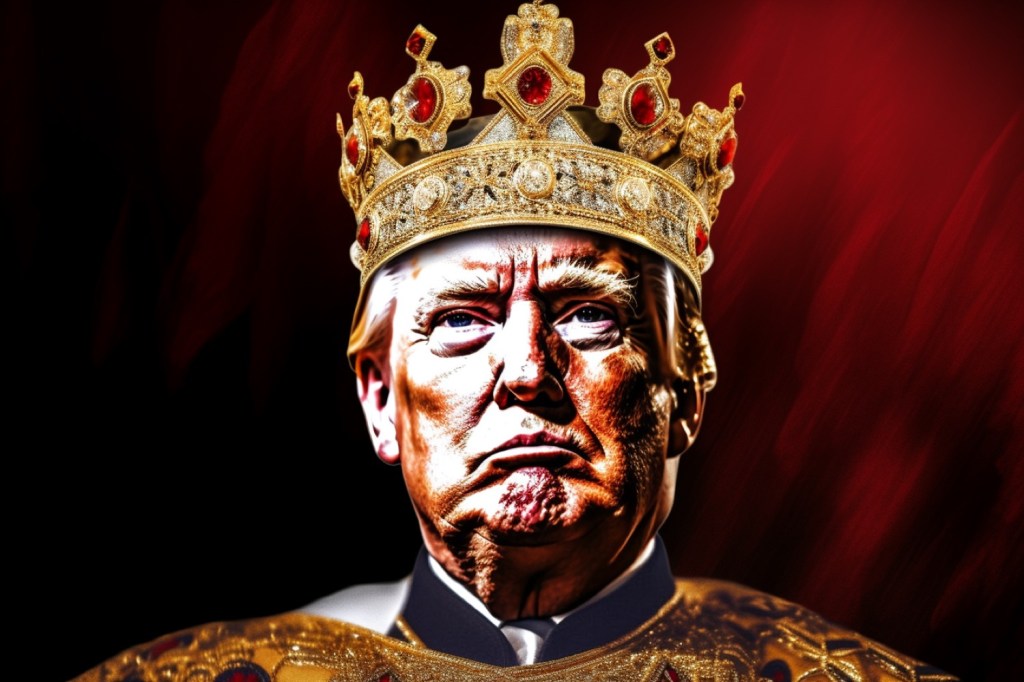
Donald Trump has been vocal in his belief that he is the supreme authority in this country over even the Constitution and legislative and judicial branches. Sadly, though, his supporters will not hold him to account but will continue to enable him. It’s clear that MAGA will not allow anyone or anything, including the Constitution, from standing in the way of King Trump consolidating his power into something far removed from what the Founders of this country intended to be held by the executive branch. As a lover of history, all this is fascinating. As someone who lives in this country, I find this brewing constitutional crisis troubling, to put it mildly. At this point, though, what disturbs me the most are the many men and women I used to respect aiding and abetting President Trump’s ascendency to total power. Bow before the golden idol, Shadrach, Meschech, and Abednego.
[1] Eric J. Segall, Originalism as Faith (Cambridge, UK: Cambridge University Press, 2018), 15.
[2] Alexander Hamilton, “Federalist 78” The Federalist Papers ed. Clinton Rossiter (New York: Signet Classics, 2003), 464.
[3] Jon Meachum, American Lion: Andrew Jackson in the White House (New York: Random House Trade Paperbacks, 2009), 204.
[4] To be clear, I am no Andrew Jackson fan. In fact, I believe that Donald Trump exemplifies the worst fears about Andrew Jackson held by the likes of Henry Clay and John Quincy Adams.
[5] Marshall was quite adroit at dodging showdowns with antagonistic presidents, starting with his convoluted decision in Marbury v Madison. Scholars believe that with Worcester v GA, Marshall was correcting his decision in Cherokee Nation v. GA the year earlier but without running the risk of either President Jackson outright defying the Court or, in the instance he forced compliance, the State of Georgia seceding from the Union, which it had threatened to do.
[6] I realize that I left out the particulars of Worcester v. GA but I have faith that interested readers know how to access Google. The particulars aren’t relevant to my point.
[7] Even Nixon complied and turned over the tapes, which ended his administration.
[8] I cannot find quote’s original source. I don’t know, at this moment, whether Roberts said or wrote those words. I googled and even poked around the SCOTUS website. Not a single media story includes a link. They all include links to Trump’s Truth post and various other statements made by Republicans and Democrats alike. Anyway, I’m sure it’s out there, just wanted to acknowledge that I’m solely relying on news sites for the quote, something I try not to do.
 Practically Known Theology