by John Ellis
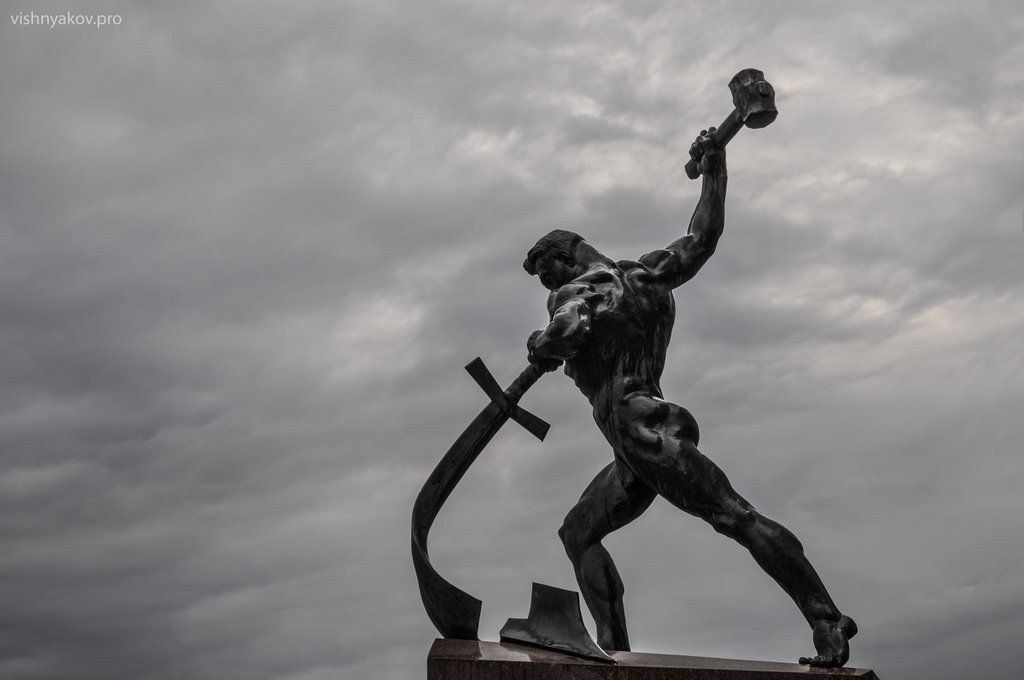
One of history’s ironies sits in the United Nations’ art garden at their New York City headquarters. Titled Let Us Beat Swords into Ploughshares, the Soviet Union gifted the U.N. the sculpture referencing Isaiah 2:4 by famed Soviet sculptor Yevgeny Vuchetich on December 4, 1959. Obviously, the Soviet Union had zero intention of beating any of their swords into plowshares.[1] During the early 1980s, adopting Let Us Beat Swords into Ploughshares as their symbol, Christian peace movements in East Germany wore patches featuring the Soviet sanctioned sculpture. Adding to the irony (East Germany and not the Soviet Union, but still), the Stasi conducted a program of oppression aimed at the Christian peace movements. Anyone wearing the patch was subject to being kicked out of school, fired from jobs, and even being thrown into prison. It wouldn’t have taken a genius political theorist in 1959 to predict Leninists condemning peace activists using the officially sanctioned Let Us Beat Swords into Ploughshares as a symbol. And this leads me to another even more tragic irony of history: Christendom’s (Western Christianity) bloodlust for war.
After Emperor Theodosius banned paganism in 392, “bishops and [Christian] mobs took these decrees as license to use force against paganism.”[2] Christians picked up swords and forced pagans to convert on pain of death.[3] The subsequent history of Christendom is littered with violence, oppression, religious wars, and the destruction of indigenous people groups in the name of Christ. In defense of Christendom, Christian apologists love to tout the body count of the supposed “secular” wars of the 20th century, pointing to the truly heinous actions of some of history’s greatest villains. While it’s true that Stalin, Pol Pot, Mao, etc. viewed humans as expendable cogs in the pursuit of their dictatorial goals, it’s historically and intellectually dishonest to use the 20th century as an apologetic to prove that the bloodlust of secularism exceeds that of Christendom.
Firstly, what an odd argument. In fact, it’s not even an argument; it’s a deflection, and a childish one at that. The belief that Christendom is exonerated, on any level, because the casualties of the religious wars are less than those of the “secular” wars is the self-serving ethic of whataboutism. Secondly, it ignores, at times intentionally I’m guessing, that the 20th century’s moral monsters had much more efficient killing machines than the moral monsters of the religious wars of previous centuries. Imagine, for example, the body count of The Thirty Years War if the religious combatants had access to machine guns, tanks, modern bombs, and fighter jets. Already, with far less efficient killing machines, the death rate of The Thirty Years War is estimated to be as high as 8 million souls.[4] Christendom’s hands are undeniably dripping with blood.[5] Whether you want to include white evangelicalism under the umbrella definition of Christendom or not, and I do (as do many of white evangelicalism’s most prominent voices/platforms), white evangelicals are doing their darnedest to make sure their hands are stained, too.
In the face of Trump’s war in Iran,[6] prayers and expressed desires for peace are being raised by white evangelicals. But those prayers ring hollow if not accompanied by denunciations of the U.S.’s current regime and calls for repentance for the violence, chaos, and murder being inflected on the world via Trump’s war. In fact, as best I can tell, white evangelicalism overwhelmingly supports Trump’s war on some level or other. Praying for peace out of one side of your mouth while expressing support for Donald Trump and Pete Hegseth out of the other side of your mouth is beyond ironic; it may demonstrate a heart that is attempting to serve two masters. What the United States military is currently engaged in will not culminate in peace any time soon. In fact, the exact opposite will be the likely end result.
It’s true that Ayatollah Khamenei was a violently oppressive, murderous dictator, a truly despicable human. It’s true that his regime that has exerted tyrannical control over Iran for nearly 50 years will go down amongst history’s worst. And as I mentioned in a previous article, there are legitimate geopolitical reasons to unseat and destroy that regime. There are ethical and theological reasons to pray imprecatory prayers over the Supreme Leadership of the Islamic Republic of Iran. All these things can be true, and they are, yet it’s also true that Donald Trump’s war in Iran is a sinful crime against humanity and should be denounced by Christians.
Scan the headlines of news outlets across the spectrum of conservative and liberal. Doing so reveals that one thing is clear: Trump and Hegseth do not have an exit strategy. At least not one that doesn’t leave Iran in chaotic tatters filled with disparate ideologies competing for control. For Trump and Hegseth, this appears to be a game in service to their egos. Trump continuously brags about the invincibility of the U.S. military, and maybe that’s true, but his boasting reveals a stunning lack of understanding about the geopolitical concerns and ramifications for the region’s aftermath of America bombing Iran into a wasteland.[7] Providing a reason for Trump’s war, the White House issued the statement, “The rogue Iranian Regime under the evil hand of the Ayatollah has killed and maimed thousands of American citizens and soldiers over the years — and that ends with President Trump.” NBC News reports, “Trump also listed four objectives for Operation Epic Fury: degrading Iran’s missile capabilities, destroying Iran’s navy, ensuring Iran can never obtain a nuclear weapon and containing its proxy forces by ensuring Iran cannot ‘continue to arm, fund, and direct terrorist armies outside of their borders.’” For his part, Secretary of War Hegseth insists that this war will not be “endless,” insisting that they have “a clear, devasting, decisive mission.” What isn’t clear is what happens after Trump becomes tired of dropping bombs and lobbing missiles into the country. Even if all four of Trump’s objectives are achieved, a vacuum will be left in Iran. Unless the U.S. is willing to fill that vacuum, something else will. The question is, what? I know what Trump and many of his supporters seem to believe is going to happen. I also know that they’ve constructed a militaristic fantasy that overwhelming force automatically leads to a good outcome.
Multiple times, Trump and his administration have bragged about how they have cleared the path for Iranians to retake their country. Iranian-American organizations have rejoiced at Khamenei’s death and what they believe is the inevitable toppling of the regime he has left behind. I’ve seen white evangelicals rejoicing along with Iranians who are overjoyed at Khamenei’s death. You know what I haven’t seen? An honest and nuanced acknowledgement of the sticky wicket Trump has created.
For white evangelicals posting videos of Iranians rejoicing, why are you not posting videos of Iranians angry at the killing of Khamenei? Just because some Iranians are happy doesn’t mean they all are. Entrenched narratives myths, like conspiracy theories, do not broach data points that do not support the existing belief system. They’re like Roman arches; every block must be just right and in place to support the whole. White evangelicals, taking their cues from Trump, who believe that Trump’s war signals a new, better future for Iran are not only ignoring history but also present-day geopolitics and the social/religious realities inside Iran. Unless Trump is committed to an extended occupation replete with a heavy-handed, totalitarian grip on Iran, the country will be plunged into a civil war. In fact, even if Trump is committed to a seemingly endless occupation, Iran will still be enveloped in violence and oppression. Trump’s war is going to go down in history as just one more instance of Western nations making a mess they created even worse.
The near constant upheaval and cycles of violence in the Middle East can be traced directly back to the condescending hubris of white people, specifically three white people representing millions of white people.
In 1919, Georges Clemenceau, David Lloyd George, and Woodrow Wilson decided to carve up the world, including the about to collapse Ottoman Empire. Without any real knowledge or understanding of the region, the Big Three parceled out the Middle and Near East with no thought to cultural affinities, shared languages, and religious differences within the borders they drew for the countries they created. The military historian Michael S. Neiberg claims, “As a group, the men in positions of power in Paris believed deeply in the superiority of white people.”[8] Owing to their entrenched racism/bigotry, the Big Three believed they knew better than the indigenous people groups what was good for the region and the world. Except the British Foreign Minister Lord Balfour, who had a front row seat to the debacle, observed the Big Three being primarily counseled by the young, inexperienced British diplomat Harold Nicolson and warned, “I have three all-powerful, all-ignorant men sitting there and portioning continents with only a child to take notes for them.”[9] Out of the Treaty of Versailles and its accompanying treaties, fuel was not only poured on the world, specifically the Middle and Near East, but the match lit.[10] The region still burns today.
Like their ancestors from Christendom’s past, white evangelicals are betraying where they believe their home is and to whom/what they owe allegiance. Trump’s war in Iran is just another in a long line of racist, condescending actions in the region that will lead to more bloodshed, heartbreak, and oppression for people groups who have suffered over a century now because of Western racist hubris. By supporting this war, white evangelicals are signaling that they are more concerned with their own temporal safety (and setting aside the ephemeral promise of safety to begin with) than they are with God’s justice. To be clear, I don’t expect any Christian to know how to put the geopolitical toothpaste back into the tube. The unjust, sinful ramifications extending back to the Big Three’s actions, the West’s colonization spirit that still lives, and the use of people of color as expendable pawns to further the West’s, specifically America’s, agenda is such a complex tangled web, that I doubt a solution is possible at this point in history. I do believe it is reasonable, to put it mildly, to expect professing Christians to speak truth to power in ways that provide testimony to the Resurrection while articulating Kingdom ethics.
It’s not an either/or: denouncing Trump’s war and calling for his repentance does not signal support for Ayatollah Khamenei and his regime. You see, as Christians our perspective, ethics, and hope should not be determined nor even shaped by any current Babylon, including the one we live in. Ultimately, our only hope is in the return of King Jesus. In the meantime, our calling is to make disciples; it’s to be an ethical emissary of a Kingdom that is not of this world while inviting people to enter Jesus’ Kingdom through faith. Supporting a war that is going to bring more misery, chaos, and oppression into an already broken world while following a man whose only god is himself is antithetical to that calling. It’s an embrace of a reversal of Isaiah 2:4. Praying for peace while supporting Trump’s war is a hypocritical denial of our calling as followers of King Jesus.
[1] Vuchetich was most known for his militaristic sculptures, adding another layer of irony. One his more famous pieces, The Motherland Calls, stands in direct contrast to Let Us Beat Swords into Ploughshares by calling Soviet citizens to war.
[2] Justo L. Gonzalez, The Story of Christianity, Vol 1: The Early Church to the Dawn of the Reformation (New York: Harper One, 2010), 141.
[3] It should be noted that this is the telos of “Christian” nationalism.
[4] Peter H. Wilson, The Thirty Years War: Europe’s Tragedy (Cambridge, MA: Belknap, 2011), 4.
[5] Some may want to argue that I’m using too expansive of a definition for Christendom. If you think that the religious nations that developed out of/because of the Reformation should not be classified as Christendom, tell me a different word to use and I’ll consider using it … maybe. Also, for what it’s worth, it appears to me that the current crop of apologists – the so-called cultural apologists – have as expansive a definition as I do. I’m largely taking my cue from them.
[6] The official name, “Operation Epic Fury,” is so on brand with Trump and MAGA’s childish self-aggrandizing.
[7] United States history speaks to this. England’s military might was far superior to the colonists. This is why George Washington engaged in what is referred to as a Fabian strategy. During the first few years of the war, his objective was to preserve his army instead of winning decisive battles, something he knew was outside of his ragtag, undertrained, poorly armed army’s capability. While the 13 colonies constituted a much smaller land mass than the current U.S., it was too big for any army to occupy completely. The size of the new nation was its greatest advantage during the early years of the war. The main goal of the Continental Army was to outlast the will of the English people and soldiers (combined with proving their mettle and determination enough to coax France into the war). The colonists were also aided by the well-intentioned, humanitarian mistakes of the Howe brothers. Both General and Admiral Howe misunderstood the conflict. They viewed the colonists as their cousins whom England wanted to welcome back into the fold. There were multiple opportunities for General Howe to go scorched earth on the Continental Army, destroying it, but he allowed his desire to not punish the colonists too much to factor into his military decisions; he didn’t want to create any unnecessary ill will in the colonists towards England. This aided Washington’s Fabian strategy, unnecessarily (from England’s perspective) prolonged the war, and allowed it to become a war of attrition of a superior force against entrenched locals who had the advantage of home field. These lessons/mistakes have been repeated throughout history: Napolean in Russia, Hitler in Russia, the U.S. in Iraq, etc.
[8] Michael S. Neiberg, The Treaty of Versailles: A Very Short Introduction (New York: Oxford University Press, 2018), 44.
[9] Margaret MacMillan, Paris 1919: Six Months that Changed the World (New York: Random House Trade Paperbacks, 2001), 435.
[10] For more on this, I recommend my Palestine and Israel series, which I’m hoping to finally finish this year.
 Practically Known Theology
Thanks. And, here’s something you might appreciate: C. Andrew Doyle and Stanley Hauerwas, “The church cannot bless war,” The Christian Century, June 27, 2025.
LikeLiked by 1 person