by John Ellis
In 1845 the American Anti-Slavery Society published a booklet titled “The Constitution a pro-slavery compact; (vol 11) or, Extracts from the Madison papers, etc.” It’s mainly composed of selected portions from Madison’s carefully kept records of the Constitutional Convention and a few other pertinent documents from the Founding era. As the booklet’s title boldly trumpets, the abolitionist society’s goal was to prove that the United States Constitution is a pro-slavery document.
The introduction, written by Wendell Phillips, responds to those who claimed that even though slavery is tolerated in the Constitution, the spirit of anti-slavery is what the Constitution at large represents. Not mincing words, Phillips thundered back, “[this booklet] prove[s] the melancholy fact, that willingly, with deliberate purpose, our fathers bartered honesty for gain, and became partners with tyrants, that they might share in the profits of their tyranny.”[1] During the same year as the booklets publication, “the abolitionist William Lloyd Garrison observed Independence Day by burning a copy of the United States Constitution.”[2]
Three years earlier, Justice Story’s opinion in Prigg v. Pennsylvania “convinced many abolitionists of what they had already strongly suspected – that the Constitution was incurably proslavery and that disunion was the only remedy.”[3] That same year, the ex-President turned Congressman John Quincy Adams, in a stunning (and brave) rebellion against the gag rule, read a letter from his constituents in Haverhill, MA, on the House floor. Not only did the letter violate the House rule against (negatively) discussing slavery on the floor, “It called for a dissolution of the union.”[4]
Threats of secession were nothing new. In one of the more famous examples, threats of secession from New England Federalists during the War of 1812 prompted the infamous Hartford Convention that met from December 1814 through the middle of January 1815.[5] The subsequent ending of the War of 1812 took much of the wind out of the sails of the New England Federalists who advocated secession. As far as the states (much farther) to the south, and while it probably goes without saying, anti-slavery petitions to Congress were never well received by Southerners. “‘Let me remind men who expect a general emancipation by law,’ warned one outraged South Carolinian congressman, ‘that this would never be submitted to by the Southern States without civil war!’”[6] As I made clear in Part 1, this country has always been divided going back to the beginning.[7]
With the election of Thomas Jefferson, “[I]t seemed to Federalists … that the America they envisioned was coming to an end.”[8]Analyzing the changes to the country under the leadership of Jeffersonian Republicans, Fisher Ames complained, “A Democracy cannot last. Its nature ordains that its next change shall be into military despotism, of all known governments, perhaps, the most prone to shift its head, and the slowest to mend its vices. The reason is that the tyranny of what is called the people and that by the sword, both operated alike to debase and corrupt, till there are neither men left with the spirit to desire liberty nor morals with the power to sustain justice.”[9] In a different essay, the always eloquent Ames made the cynical prophecy that, “We are sliding down into the mire of a democracy, which pollutes the morals of the citizens before it swallows up their liberties.”[10] Gordon Wood quotes the Harvard educated editor and Federalist Joseph Dennie who warned in 1803 that “a democracy is scarcely tolerable at any period of national history. Its omens are always sinister. … It is on trial here, and the issue will be civil war, desolation, and anarchy.”[11]
While the term stochastic terrorism had yet to be invented[12], the angry, pejorative-laced rhetoric resulted, predictably, in violence. In 1798, a fight broke out on the House floor between Federalist Congressman Roger Griswold (CT) and Republican Congressman Matthew Lyon (VT). An argument about President Adam’s desired war against France became personal and Lyon spit tobacco juice in Griswold’s eye. The Federalists attempted to have him kicked out of Congress but were unable to muster the needed two-thirds majority. An impatient Griswold took matters into his own hands and attacked Lyon with his walking stick. Lyon fought back with fireplace tongs.
In 1806, a Massachusetts Republican editor named Benjamin Austin insulted Thomas Selfridge, a Federalist lawyer. When he didn’t receive the public apology he demanded, Selfridge, “publicly posted Austin as ‘a coward, a liar, and a scoundrel.’”[13] After Austin’s eighteen-year-old son, defending his dad’s honor, attacked Selfridge in the street with his cane, the lawyer pulled a pistol and killed the young Harvard student. For months afterwards, Boston and the surrounding area were rocked with political violence as both Federalists and Republicans sought vengeance.
Within those historical anecdotes lies prophetic echoes of Hillary Clinton’s “deplorables” and Donald Trump’s labeling of Democrats as “scum,” “vermin,” and “enemies of the people.” That type of language in our political discourse is as old as the political life of this country. Those anecdotes, and the many similar anecdotes I left on the “cutting room floor,” also help us understand the wide divisions that propelled the assassins’ bullets that tragically ended the lives of Charlie Kirk and Melissa Hortman. And they help us in our understanding because America’s history is filled with people talking past each other because they are unable to hear each others’ voices from across the divide. In turn, and as a direct result of the inability to hear each other, that same history is pockmarked with acts of violence precipitated by angry political words. What all this means, though, is hard to accept: A house divided cannot coexist. The American experiment is proving unworkable. The societal divisions – cultural wars – are unbridgeable and, therefore, unresolvable, making the continuation of the Republic (as is) unsustainable.
Before dismissing me, keep reading; my argument is not finished. In fact, it hasn’t even really begun.
Before driving for Uber, among other boxes to check, prospective drivers are required to watch a video about acceptable conversations with passengers. It’s mostly boilerplate H.R. absurdities infantilizing drivers and passengers alike. I do understand that not everyone possesses the baseline level of common sense needed to know that telling your female passenger that she looks hot, for what should be an absurd example, is out of bounds. Mocking the video doesn’t mean that I don’t recognize the (silly and sad) necessity for it. That being said, if you take it too seriously, about the only topics left to discuss with passengers are the weather, sports, and cooking. It also hasn’t escaped my attention that after nearly 5,000 rides as an Uber driver, the majority of my conversations with passengers are in clear violation of Uber’s policies. To be clear, in case anyone at 1515 3rd Street, San Franscisco is reading, as a general rule I allow the passenger to choose what we’re going to talk about; politics is one of the main taboo conversations passengers want to have in my car.[14]
Acknowledging that my “data collection” (probably) fails to meet the rigorous standards expected of data scientists,[15] I do believe that I have been exposed to a large enough cross section of America in my car[16] to assert this (it’s also not a controversial, groundbreaking assertion): Based on political conversations in my car, Americans, regardless of political persuasion, age, ethnicity, gender, and socio-economic class, believe the country is broken. To reiterate, no matter the political persuasion, not a single Uber passenger that has discussed politics in my car believes that the United States of America is functioning as the Founders intended. Some believe the country is headed in the right direction, while others think otherwise but believe in the healing power of democracy. A few are scared for the future but can’t articulate arguments that support their fear. And, importantly, my passengers disagree about what the Founders intended this country to be, almost exclusively along party lines.
I’ve surveyed a variety of polls taken since the second inauguration of President Trump. While I haven’t found any that ask if the country is functioning as the Founders intended, I do think the questions and responses reflect my contention. Most of the polls – almost all of them – pose the question in terms of the direction of the country. The results are partisan, as to be expected. For example, at the moment, Republicans are more likely than Democrats to believe that the country is headed in the right direction. Citing an NPR poll from September, “By a 62%-to-38% margin, respondents said they believe the country is headed in the wrong direction.” I’m sure you can guess the political breakdown in that number. In contrast, exit polls after last year’s presidential election showed that 72% of voters believed that America was headed in the wrong direction. That number has shifted quite a bit, of course, but Americans are still unhappy with where the country is; they just disagree on if it’s now headed in the right direction. What’s frightening, as the NPR article warns, is that “[t]hree in 10 people now say that Americans may have to resort to political violence to get the country back on track.” For now, more Republicans – 31%, a slight rise since last year – believe that violence may be necessary than Democrats. However, “[e]ighteen months ago, just 12% of Democrats agreed; now, 28% do.”
An article by syndicated columnist Jessica Johnson in The Inter-Mountain, dated October 14, 2025, and titled “Americans Growing Increasingly Pessimistic,” begins – the second sentence, actually – by mourning that, “After the troubling political violence we have witnessed recently, it is not shocking that a majority of those surveyed believe we are in a dire situation.” Citing a recent Associated Press-NORC Center for Public Affairs survey, Johnson buttresses her lament with a variety of poll numbers demonstrating that many Americans, on both side of the aisle, believe that the country is broken and headed in the wrong direction. Illustrating her thesis, she writes, “One quote from a 42-year-old truck driver and father who was interviewed particularly stood out to me because he expressed concern about our growing political divide. ‘We are … supposed to be united as a country and coming together. And we are not,’ he said. ‘I’m so perplexed how we’re not on the same page about anything, so bad that (people) are being shot.’ Another interviewee, 55, said, ‘Nobody has respect for anybody anymore. It’s sad.’”
I’m not perplexed that Americans are “not on the same page,” and don’t believe anyone else should be either. To help explain, I’m going to point to a well-intended yet ultimately futile bumper sticker I saw this past summer.
The largest words on the bumper sticker sarcastically screamed “Is America Great Again Yet?” Preceding it, and I’m paraphrasing/half-guessing on some of these because I saw the bumper sticker a few months ago and didn’t take a picture of it, was a list of things being enacted by the current administration. The list included things like, “Transgender rights are being trampled,” “Immigrant families are being detained and deported,” and “Religion is being forced back into public schools.”
First off, that’s way too many words for a bumper sticker but, whatever. Secondly, and far more importantly, the intended audience/target of the question will read that list and conclude, “Well, if those things are true, then the country IS being made great again.”
And therein lies the rub: when there are diametrically opposed understandings of what America was, is, and should be, productive communication is practically impossible. The two sides will inevitably talk past each other. The divides in this country aren’t of degrees; they’re ontological in nature, making them a zero-sum game. The differences aren’t of the kind in which the two sides can simply agree to disagree because ceding any ground to the other side is an existential threat. This should be obvious, but for some reason it’s not.
At the beginning of this past summer, I gave a young man, freshly graduated from Harvard, a ride to the airport. He had been visiting Central Florida with friends, celebrating graduation, and was flying to Sacramento to begin his job. Armed with his degree in Government, he had secured a position working for someone in the California state legislature. He didn’t tell me whom he was working for or what his job entailed, and I didn’t ask. We did discuss politics, though.
From the brief introduction he gave me about himself, I could tell he was excited about beginning his career in politics. Curious, I asked, “Are you optimistic about the future of this country?”
He didn’t even think about it before blurting out, “Yes!”
Genuinely impressed by his optimism, I listened as he admitted that things were bleak and currently headed in a bad direction, mentioning several issues – LGBTQ rights, immigration – that he’s worried about for the immediate future. He confidently added that he has full faith in the democratic process, and that he believes the American people will be able to move past their differences in order to make a better society for all. The conversation took place several months ago, and I can’t remember it verbatim, but he was firm in his belief that this country’s current trajectory isn’t going to last. Condensing and paraphrasing, while using my own editorializing language, his belief in the progressive Utopian dream was unshaken. At least, that is, until he politely turned the question on me.[17]
After confessing to a high level of cynicism, to put it lightly, about the future of this country, I challenged him with a thought experiment. He had previously explained that dialogue – better dialogue – is an important key to finding unity again in this country. With that in mind, I asked him how two people who are on opposite sides of the abortion debate can reach agreement. After briefly thinking about it, he corrected me, “It’s not necessarily about agreeing; it’s about finding ways to agree to disagree,” and then proceeded to work through the standard pro-choice talking points, emphasizing the necessity to extend rights to even those we may disagree with. After he had finished, I asked, “But if someone truly believes that abortion is murder, at which point can they agree to disagree? I mean, how can they agree to extend the right to someone to murder someone else?”
Before he could respond, I pushed forward. “For the sake of argument,” I urged him, “place yourself in the ideological position of a person who believes that abortion is murder. Which of the points you just made can you now, believing that abortion is murder, agree to disagree with?”
He was a little flustered, which wasn’t my goal, so I quickly added, “I’m not trying to argue with you, or convince you that your position is wrong. My point is that for an issue like abortion, even to reach the point of agreeing to disagree, what’s usually required is an almost complete shift in peoples’ worldview.”[18]
We then talked about how abortion is ultimately an either/or. You either believe women should have the right to have an abortion, or you believe they shouldn’t. And I know what you’re (likely) thinking because I’ve had this conversation multiple times in my car.[19] As I’ve been reminded several times, there are gray areas within the abortion debate. Sure, I get that, but once you start allowing for nuances and variables, you’ve landed on a specific side of the initial either/or. In doing so, while you can find room to agree to disagree – late term abortion or not, for example – within that parameter, the fact remains that your disagreement with those who believe abortion is murder[20] is far past the point of agreeing to disagree. The issue becomes a zero-sum game.
We briefly touched on several other hot-button issues – same sex marriage, transgender rights, and immigration – and while he was unwilling to completely concede my point that dialogue is impossible in some cases and highly improbable in others, he admitted that the divisions were wider than maybe he was willing to see.
Bridging the cultural war divides in order to find common ground is not as simple as changing each other’s mind on a point or two. It’s even more complex than playing epistemological pick-up-sticks.[21] As philosopher Charles Taylor astutely puts it, “Selfhood and the good, or in another way selfhood and morality, turn out to be inextricably intertwined.”[22] Most of us believe that we’re self-defining subjects, at least to some degree. One of the problems with that belief is that our definition of ourselves is interconnected, if not controlled, by how we define flourishing – our worldview, including our political opinions and position. And we don’t acquire our worldview in a vacuum. Not a single one of us, no matter how much we may want to believe otherwise, looked through a worldview catalogue and said, “I’ll take that one.” Many of the more hot-button cultural war issues are connected to our identity because they either support or undermine what we believe leads to flourishing.
I’m not claiming that every policy position requires an existential upheaval before someone can change their mind. That would be absurd. What I am claiming is that our politics – our understanding of what the polis is and how it should operate – isn’t divorceable from our worldview. Since our worldview plays an outsized, determinative role in how we define who we are, politics is largely undivorceable from how we define ourselves. While not every policy position requires existential upheaval to find common ground or change your mind about, agreeing to disagree about the overall understanding of how society works best does demand existential upheaval. And this reality – this problem – is an evolving refutation of one of the central tenets embedded in the political philosophy of this country’s founding articulated primarily in The Federalist Papers No. 10 and No. 14, both written by James Madison, No. 2 written by John Jay, and No. 9 written by Alexander Hamilton.
One of the more forceful arguments made during the debates over the proposed Constitution against the Federalist vision for America was that the thirteen, soon to be fourteen (Vermont), states encompassed too large a land mass containing too diverse of a population to work as a republic.[23] Too many people would be pulling in different directions. “Classical political theory had suggested that republics could only thrive in geographically and demographically small societies,” writes Yale law professor Akhil Reed Amar, “where citizens would be shaped by a common climate and culture, would hold homogeneous worldviews, would know each other, and could meet face-to-face to deliberate on public issues.”[24] Keep in mind, the citizens of the fledgling nation were “among the most heterogeneous people to be found anywhere along the Atlantic littoral in the eighteenth century.”[25]
Pushing back on the generations of received wisdom in political theory, Alexander Hamilton made the point that republics have historically been too small to protect themselves from the chaos and violence created by disgruntled insiders. “A firm Union will be of the utmost importance to the peace and liberty of the States as a barrier against domestic faction.” Hamilton then insists, “It is impossible to read the history of the petty republics of Greece and Italy without feeling sensations of horror and disgust at the distractions with which they were continually agitated, and at the rapid succession of revolutions by which they were kept in a state of perpetual vibration between the extremes of tyranny and anarchy.”[26]
For his part, in The Federalist Papers No. 14, Madison claimed that if the polis is small enough for everyone to meet face-to-face to deliberate on public issues, it would be too small to muster enough soldiers to defend itself. Even the tiny state of Rhode Island was too big to subscribe to the classical requirements of a republic. With that in mind, however, if France or Spain or England invaded the “Republic of Rhode Island,” the betting odds would not favor the fine folk of Providence. As Madison shrugged, “It may be inconvenient for Georgia, or the States forming our western or northeastern borders to send their representatives to the seat of government; but they would find it more so to struggle alone against an invading enemy.”[27]
Along with others, especially Jefferson, Madison envisioned a possible scenario where the nation’s borders encompassed the entirety of both the North and South American continents. He realized that a nation that large would be next to impossible to conquer.[28] The supply line issues would become a nightmare for invading armies, especially during the pre-industrial times Madison lived. He also scanned the vast oceans and saw natural defensive barriers. But all that would only work if the states were united by more than a loose, toothless charter; they had to become one nation under a strong federal government – a large republic.
John Jay tackled another of the arguments against such a large republic in No. 2. “Providence has been pleased to give this one connected country to one people – a people descended from the same ancestors, speaking the same language, professing the same religion, attached to the same principles of government, very similar in their manners and customs.”[29] None of that was true, of course. At least not to the extent Jay seemed to claim. His point, though, must be understood in the context of how the Federalists defined it. Akhil Reed Amar points out that, “Jay noted the many ways in which (white) Americans share a basic homogeneity that constituted them as one people.”[30] I would add that even with the construct of “white,” Jay overstated that homogeneity. There were many differing and competing ways in which the various groups of white Europeans already in America understood religion, politics, family, and society in general. This overstatement is one of the initial cracks unintentionally left by the founders in the foundation of this country.
To tie together the various arguments in support of a large republic with a coherent, cogent political theory, Madison introduced his all-important skimming principle in No. 10. In summation, he saw a society in which the best of men rose to the top (governance) via the election process, like how cream rises to the top of a pail of milk. While making his argument, he defines the paradox of liberty. “Liberty is to faction what air is to fire, an aliment without which it immediately expires. But it could not be a less folly to abolish liberty, which is essential to political life, because it nourishes faction than it would be to wish the annihilation of air, which is essential to animal life, because it imparts to fire its destructive agency.”[31] He then points out that a citizenry allowed suffrage would naturally look out for its individual best interests instead of what’s best for the collective, concluding, “The inference to which we are brought is that the causes of faction cannot be removed and that relief is only to be sought in the means of controlling its effects [emphasis kept].”[32] Madison believed that the “means of controlling its effects” was found in “a chosen body of citizens, whose wisdom may best discern the true interest of their country and whose patriotism and love of justice will be least likely to sacrifice it to temporary or partial considerations.” This group of elected elites would “refine and enlarge the public views.”[33] This second crack in the foundation is like the first.
It takes either an absurd level of naivety or willful blindness to survey the mass of elected politicians, starting with 2025 and working backwards, and conclude that “the chosen body of citizens” have exhibited consistent levels of wisdom, love of justice, and the willingness to sacrifice temporal considerations to the greater good. Madison’s assumption that the voters would only elect the most virtuous, wisest, and most self-sacrificing individuals was born out of his own unique naivety. “The Federalists assumed in traditional eighteenth-century fashion – and it was an assumption they never lost – that no free government could long exist without the people’s confidence in the private character and respectability of the governing officials.”[34]
As I pointed out above, the foundation of this country has sizeable cracks in it that were part of its initial construction. Whether the authors of The Federalist Papers actually believed in the homogeneity of white Americans or not is irrelevant. Keep in mind, The Federalist Papers, by definition, is a partisan, didactic document. They did truly believe, however, in the necessity of wise, virtuous elected officials. The error in their second assumption was the belief that the voters would only vote for the best, as they defined it, individuals in the community to serve as elected officials. Their error with their insistence on the homogeneity of America is one of the things that allowed them to make that second error.[35]
Partisanship and competing interests immediately began making their presence known in the United States of America. There’s no need to cover the same ground covered in Part 1 as well as above. I’ll simply repeat that this country has always been divided in no small part because of its heterogeneity. Madison and company were fooling themselves, if not trying to fool others, by believing that the people in the thirteen states were pulling in the same direction. The large republic they advocated for had seams that were continually being stretched until they finally ripped apart in 1861. Furthermore, Madison’s understanding of pluralism is way undercooked compared to contemporary understandings of pluralism. And contemporary pluralism has ripped open seams Madison could never have dreamed of.
If you notice, except for my opening in Part 1, the historical events and anecdotes in this series all happened before the Civil War. That doesn’t mean that divisions and political violence have been absent from American culture since 1865. Quite the opposite, in fact. Ask William McKinley, for one. Since 1865, though, something else has happened: contrary to the Federalist vision for this country in 1787, democracy has spread. The extension of civil liberties and suffrage has been the primary theme of the Constitutional amendments starting with the 13th.[36] The 13th, 14th, 15th, 17th, 19th, 23rd, 24th, and 26th amendments all deal, directly or indirectly, with the extension of suffrage and/or civil liberties. Add in the Warren Court’s impact, and the United States of America in the 21st century looks nothing like the claim made by John Jay in Federalist no. 2. Too many disparate voices and opinions are allowed, in theory, equal play now. When that happens, when disparate voices and opinions are allowed equal play, the interpretation of America clashes. The responses to the assassination of Charlie Kirk bear this out.
On the Saturday following the tragic death of Kirk, a pastor friend reached out to ask if I would give him some advice about what he should say from the pulpit the next day. After thinking about it, I told him that whatever had been said in his church about the assassination of Minnesota state representative Hortman and her husband should frame what is said about the assassination of Charlie Kirk. The problem with my advice is that it will be read as overly partisan by many on one side. In fact, it’s likely to be read as partisan by many on the other side, too.
One group of Americans believe that Charlie Kirk is a martyr and should be honored as such. The other side, while condemning his killing, view Kirk as representative of all that’s wrong, if not evil, with America. There are even those who celebrate his murder. Those two main beliefs are not reconcilable, and that’s leaving out the third. For those two sides, the assassinations of both political figures are not the same thing and do not carry the same import. One is a tragic killing. The other is an attack on America.
The main divide in this country is such that if you accept MAGA’s understanding of and vision for America, then Trump is right; the Democrats are the enemy of the people, even though you get along just fine with your Democrat coworkers. Likewise, if you align with the Democrats, then Hillary’s pejorative of deplorables makes very real sense to you, even if you wouldn’t use the word to describe your MAGA neighbors. You also likely believe that the Republican Party is dominated by a growing fascism. And here’s the important point: the belief of both sides is correct when looked at from their perspective (their worldview).
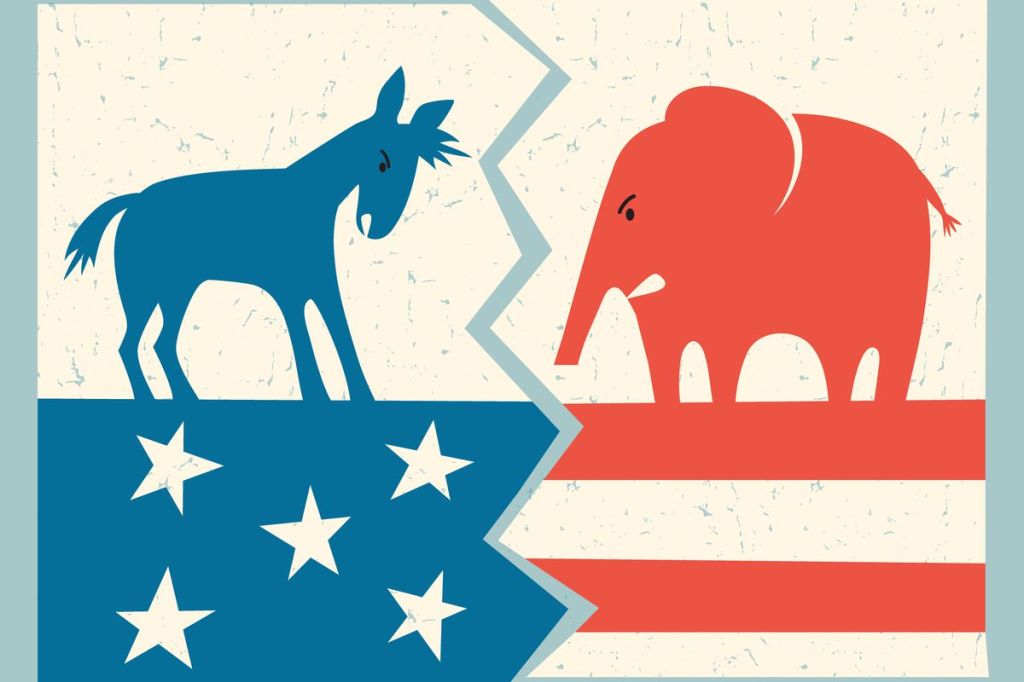
The Democrat Party’s agenda is not acceptable from the perspective of someone who is MAGA or MAGA adjacent.[37] Likewise, MAGA’s agenda is not acceptable for an actual Democrat. There are some nuances that I’m leaving out, I get that; “actual Democrat” is my attempt to acknowledge it. I realize that there are Americans who appear to be middle of the road – neither Republican nor Democrat. And some who claim to be Democrat but who voted for Trump because they believed the price of groceries would drop, for example.[38] The larger point stands, though, the two main parties in this country have agendas that are not reconcilable.[39] And one side’s vision of what America was, is, and should be will win out. They cannot coexist.
A house can become so divided that it ceases to exist. It becomes two houses vying to occupy the same space. It appears the Republicans may have figured this out before the Democrats. Even if true, the Democrats aren’t far behind. And keep in mind, “The Civil War erupted because the American people refused any longer to overlook their competing conceptions of their founding charter.”[40] I’m not predicting another civil war in the same sense as the one fought between 1861-1865. For one thing, the divide isn’t nearly as sectionally delineated as it was in 1861. I know this, though: If we’re not already there, a day will come, and soon, when enough people set aside the myth of pluralism and stop pretending that we want the same country that something will have to give. What that is, I don’t know. But whatever it is, a large percentage of current Americans will be excised from society in very real ways. The Constitution’s “We the People of the United States” will be as laughable as it was in 1787 because the “domestic Tranquility” and “the Blessings of Liberty” will again only apply to a certain set of people, regardless of which side wins. A house divided cannot coexist.
[1] Wendell Phillips, “The Constitution a pro-slavery compact; (v.11) or, Extracts from the Madison papers, etc.” (New York: American Anti-Slavery Society, 1845), viii.
[2] Michael Vorenberg, Final Freedom: The Civil War, the Abolition of Slavery, and the Thirteenth Amendment (New York: Cambridge University Press, 2004), 8.
[3] H. Robert Baker, Prigg v. Pennsylvania: Slavery, the Supreme Court, and the Ambivalent Constitution (Lawrence, KA: University Press of Kansas, 2012), 155.
[4] Baker, Prigg v. Pennsylvania, 155.
[5] Owing to the success of the propaganda campaign against it, the Hartford Convention has gone down in history as an act of treason in the minds of many. It wasn’t. In fact, it was the voice of moderation preventing the radical cries for secession from gaining ground.
[6] Gordon S. Wood, Empire of Liberty: A History of the Early Republic, 1789-1815 (New York: Oxford University Press, 2009), 524-525.
[7] I have left untouched the history of this country from the last few decades of the 19th century through the 20th century, with the exception of the opening paragraph in part 1. I could tell that story, though, if people want. And that story has many of the same partisan divides and violent notes as the late 18th through the early19th century.
[8] quoted by Wood, Empire of Liberty, 303.
[9] Fisher Ames, “The Dangers of American Liberty” Works of Fisher Ames (Memphis, TN: General Books, 2010), 256.
[10] Fisher Ames, “The Mire of Democracy” The Federalist Literary Mind: Selections from the Monthly Anthology and Boston Review, 1803-1811 ed. Lewis P. Simpson (Baton Rouge, LA: Louisiana University State Press, 1962), 54.
[11] Wood, Empire of Liberty, 322.
[12] Gordon Woo, a mathematician, came up with it in 2007.
[13] Wood, Empire of Liberty, 334.
[14] There are times when passengers treat me like their priest and my car like a confessional booth. Those times have been reduced almost to zero ever since I began setting my trip preferences to only receive ride requests from passengers with a 4.8 rating or higher.
[15] I don’t actually know. I’m assuming their standards are higher.
[16] I do drive in Orlando, after all. Not only are a large percentage of us living here not from here, but my car is regularly occupied by one or more of the nearly 80 million tourists the area receives annually.
[17] I use the descriptor “politely” because at that point, he wasn’t really that interested in what I thought. I get it. It doesn’t offend me that passengers aren’t that interested in their weird, middle-aged white-dude Uber driver’s opinions. To be fair, I am incredibly uninterested in what most of my passengers have to say although I pretend otherwise (look, I’m still an actor, Ma!). The ride I describe above is the exception, not the rule.
[18] I used the word “murder” deliberately so as to avoid having to agree on specific nuances. I will say here, though, that even if someone who is opposed to abortion doesn’t think of it as murder but believes that it still results in the death of another human being, my point still stands. In fact, and here’s where the rubber really starts meeting the road, for someone who is pro-abortion yet believes it ends the life of another human being, for that individual to win over an anti-abortion individual still requires a worldview change. To agree, the anti-abortion individual will have to embrace the specific form of utilitarianism held by the pro-abortion individual, meaning they will have to change their worldview.
[19] I had it this past weekend with a lady from Baltimore whom I picked up at the airport and drove to her resort at Universal. The conversation started with her lamenting that she was missing the “No Kings” rally, providing insight into her politics. The ride ended with me getting her suitcase out of the trunk and her confessing that she had never really considered the implications of the abortion debate being a zero-sum game. That conversation helps illustrate why I believe that Republicans may have figured all this out before Democrats.
[20] It should be noted that while many who are anti-abortion resist using the word “murder,” they, too, believe that abortion is murder. They believe that a woman who has an abortion has unlawfully (before God, natural law, etc.) killed another human being.
[21] A flaw of the progressive movement of the 20th century, and even going back to the late 18th century, was the entrenched belief that education was an all-important key for change. Give people the right information and they’ll do the right thing. It was the near-constant demonstrations of how this philosophy was woefully wrong – the big demonstrations being WWI and WWII – that led to the development of Critical Theory, one of the current MAGA boogeyman.
[22] Charles Taylor, Sources of the Self (Cambridge, MA: Harvard University Press, 1989), 3.
[23] The popular arguments over whether this country was founded as a republic or democracy have way more heat than light. Within political theory – contemporary political theory – certain definitions of a republic are included under the larger umbrella definition of a democracy. The founders of this country, particularly the Federalists – you know, the ones who wrote the Constitution – were opposed to a democracy, at least how they defined it. And in different documents written by different people during that time, how the words “republic” and “democracy” were used shifts quite often. Most times, when I hear people arguing one way or the other, I think, “They’re saying the same thing; they’re just defining the terms differently and don’t realize it.”
[24] Akhil Reed Amar, The Bill of Rights (New Haven, CT: Yale University Press, 1998), 9.
[25] Gary Nash, The Unknown American Revolution: The Unruly Birth of Democracy and the Struggle to Create America (New York: Penguin Books, 2005), xv.
[26] Alexander Hamilton, “No. 9: The Union As A Safeguard Against Domestic Faction and Insurrection” The Federalist Papers ed. Clinton Rossiter (New York: Signet Classic, 2003), 66.
[27] James Madison, “No. 14: Objections To The Proposed Constitution From Extent Of Territory Answered” The Federalist Papers ed. Clinton Rossiter (New York: Signet Classic, 2003), 98.
[28] Check with those who’ve invaded Russia.
[29] John Jay, “No 2: Concerning Dangers From Foreign Force And Influence” The Federalist Papers ed. Clinton Rossiter (New York: Signet Classic, 2003), 32.
[30] Amar, The Bill of Rights, 9.
[31] James Madison, “No. 10: The Same Subject Continued” The Federalist Papers ed. Clinton Rossiter (New York: Signet Classic, 2003), 73.
[32] Madison, The Federalist Papers, 75.
[33] Madison, The Federalist Papers, 76.
[34] Wood, Empire of Liberty, 203.
[35] I had a whole section – a few paragraphs – on the Federalists belief in who was qualified for public office and why. The short answer: rich, landed gentry who didn’t have to work for a living. This belief has roots going back to Aristotle’s Politics VII. Aristotle didn’t believe that merchants, artisans, or artists should be allowed to have a voice in the polis. I deleted the paragraphs because they seemed unnecessary to my argument.
[36] The Congressional debates over the 13th amendment are fascinating for several reasons. One of those reasons was the debate over the legitimacy of amending the Constitution. The gap between the 12th and 13th remains the longest time this country has gone without amending its founding document.
[37] I know that some of you dislike Trump but like what he’s doing, by and large. You may not physically wear the red hat, but in your heart you do.
[38] In the days after the election, driving Uber, I was fascinated by how many People of Color in my car told me they voted for Trump. And EVERY SINGLE ONE gave the price of groceries as their main reason.
[39] I wish I didn’t believe I need to say this again, but I’m not claiming that there are no issues that the GOP and the Dems can’t find common ground on. In the main, though, the two parties have contradictory understandings of what this country was, is, and should be.
[40]Vorenberg, Final Freedom, 9.
 Practically Known Theology
Many, many years ago, my professor (the late Jack Paynter), in a class on the history of civil rights law in the US, told us something to the effect of: the political system of the United States, and in particular the electoral system, “works” by treating fundamental moral commitments as “private concerns,” which don’t matter for “political life.” The practical problem is that those fundamental commitments actually matter to people, who experience conflicts about them as problems. So people keep trying to use the political process to solve the problems created by those conflicts. So they bring the conflicts to the political system – where they cannot be resolved, and never go away. I think of that class often these days.
LikeLiked by 1 person